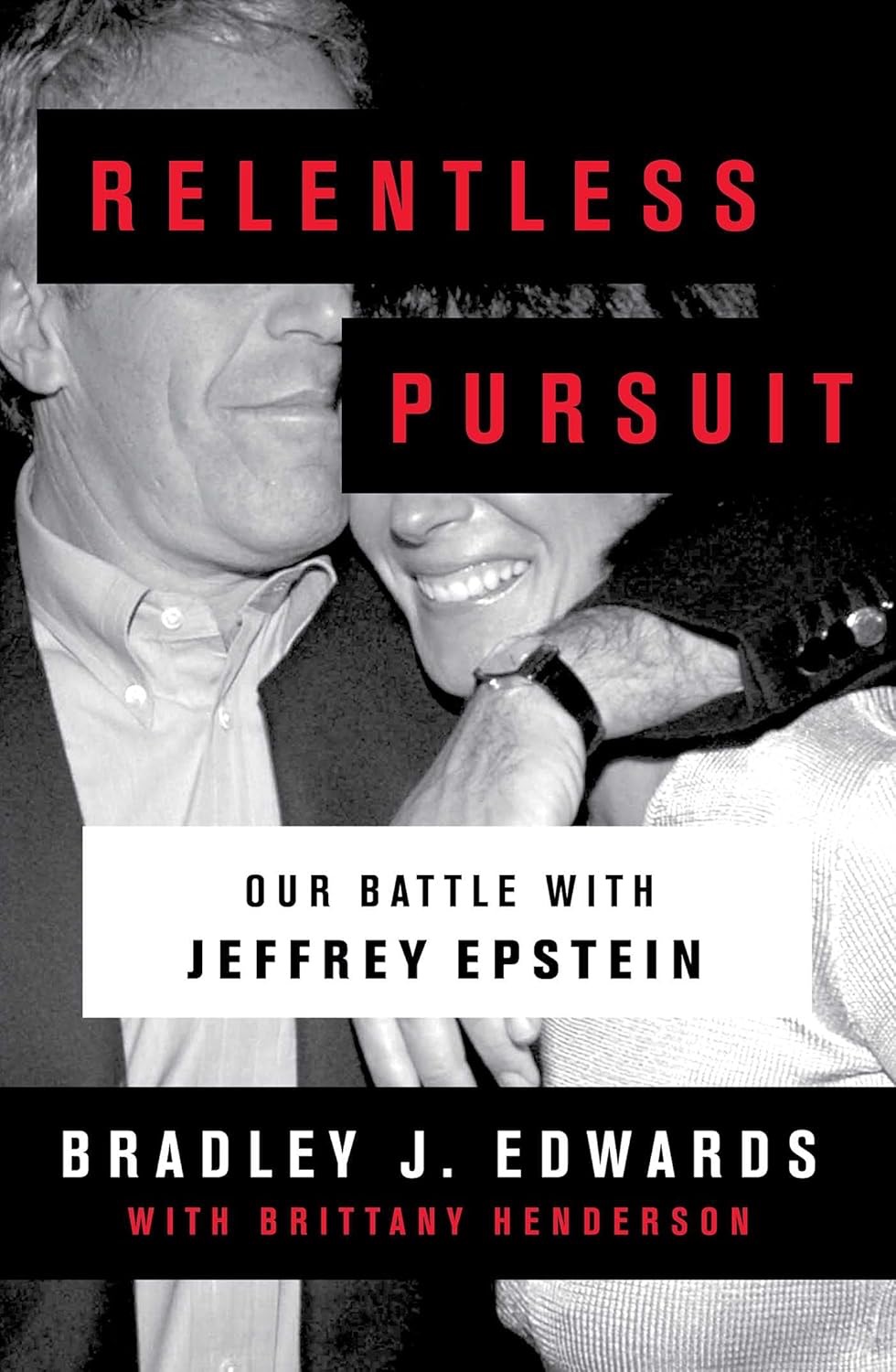
Relentless Pursuit. Our Battle with Jeffrey Epstein

Bradley J. Edwards with Brittany Henderson

My last review was Nobody’s Girl by Virginia Roberts Giuffre. I started that book because I was intrigued by the actions of the then Prince Andrew, who immediately after that book was published lost his Royal titles.

That book sent me down a rabbit hole of research. I had heard of Jeffrey Epstein, and was vaguely aware of the crimes he was ultimately arrested for. But I had no idea of the Epstein empire, the type of person he was, and the high level relationships he incubated, and the reach those relationships had.

As fascinating as Nobody’s Girl was it was a single persons account and I was desperate to find other accounts of Epstein’s activities.

Relentless Pursuit stood out. Written by two of the people that were involved in trying to prosecute Epstein and get him in prison.

Edwards, and the book, are mentioned by Giuffre in her book, and she was full of praise for his tenacity in prosecuting a man many people thought was untouchable. So what better place to start my extended reading.

In June 2008 Edwards was a young lawyer opening his first law firm. He had never heard of Jeffery Epstien. A young 20 year old woman, Courtney Wilde was referred to him by a friend. She stated she had been sexually abused by Epstien from the age of 14.

And so it began.

What follows is years of tenacity on Edwards’ side, and years of lies and deception on Epsteins.

As Edwards’ investigations gather momentum more witnesses start to come forward, one of which is Jane Doe 102, Virginia Roberts Giuffre. Although a star witness, and a person who does as much to bring down the Epstien empire as anybody, a person who Edwards finds himself admiring for her bravery in standing up, it’s very telling that his first emotion was excitement at getting one of “Epstiens inner circle” to testify against him.

That line in the book, the one of Epstiens Inner Circle, exhibits the depth of her involvement.

Epstien’s only defence is attack

In fact he attacked every lawyer, and every victim those lawyers represented with either lawsuits or intimidation tactics, and often both.

The sphere of Epstein’s influence is clearly displayed when he made a Plea Deal in 2008, which saw him serve a minor sentence, during which time he spent nearly every day in a charity foundation office next to the jail. A foundation he set up so that he could spend his days in relative comfort.

This deal saw him convicted of relatively minor crime but the deal he struck was a none prosecution deal for all of the major charges he could have been charged with, including sex trafficking and rapping underage girls.

The frustration Edwards and his team felt at this is palpable in the book. The only avenue they now had was civil suites.

But Epstein was in full attack mode. Edwards had been employed for a short time by a law firm whose director was found to be running one of the world’s biggest ponzie schemes, that’s a whole other story worth looking into.

Epstein accused Edwards of not only being involved in the scheme but also being the main orchestrator. A fact he knew from the start to be false.

This tied Edwards and his team up, distracting them for years.

All the time Edwards and Epstein had occasional off the record meetings in, of all places, a Starbucks coffee shop, no other lawyers or representatives being present. Edwards likens his dealings with Epstein as a complicated game of chess. During these meetings he relates how Epstein is cheerfully friendly, as if he is talking to a friend, but every meeting held an alluded to, or indirect threat that Edwards was going to be ruined professionally and financially, because he hadn’t got the resources or money that Epstein had available to him.

Neither did Edwards have judges, politicians, senators, and many other highly placed people in his pocket.

When the direct fight against Epstein seems impossible the team go after his close associates. In particular Ghislaine Maxwell.

Maxwells is as close to a girlfriend as you can associate with Epstein, but is also his chief recruiter. A woman that finds underage girls and cons them into sexual activities with Epstein, often taking part in the sessions and abusing the girls herself.

This is when the castle walls around Epstein start to crumble.

The accusations made against Maxwells opens the possibility of new charges against Epstein.

Still the civil cases continue, as does Epstien attacks in the victims and their lawyers.

Until the final day of reconning, the day of Epstien ultimate arrest and his eventual death in prison. Another story that needs reading into.

Throughout the book there are allusions to Epstien real status. Was her working for governments, American, Israel, or both, or more.

He was certainly protected at very high level in America and had such people as Bill Clinton amongst his closest associates.

Evidence is presented in the book suggesting the Epstein facilitated large a money transfers between America and Israel. A former Israeli Prime Minister is mentioned in this book as being one of his associates, and in Nobody’s girl Giuffre recounts being viciously assaulted by a foreign politician, it’s not hard to make the connections.

Why did Epstein get away with what he was getting away with for so long. This book establishes, with information that is now freely available, that he was above the law for a long time.

It also establishes connections between him and high ranking officials in America.

Was he working for governments, was he establishing dark routes for money transfers. It’s still all very vague and still really intriguing.

Will this be the last book I read on this subject. Certainly not.

What started for me as a passing interest in what “Randy Andy” had been up to has developed into a fascination about a very dark period in recent history.

This book, and the story it contains, reads like a Grisham thriller mixed in with a Clancy espionage book. But as fanciful as those two authors stories are, this is pure fact.

The link below is to my review of Nobody’s Girl. Whichever you read first the other compliments it.

https://nigeladamsbookworm.com/2025/10/31/nobodys-girl-virginia-roberts-giuffre/

Pages: 399. U.K. Publisher: Simon and Schuster.
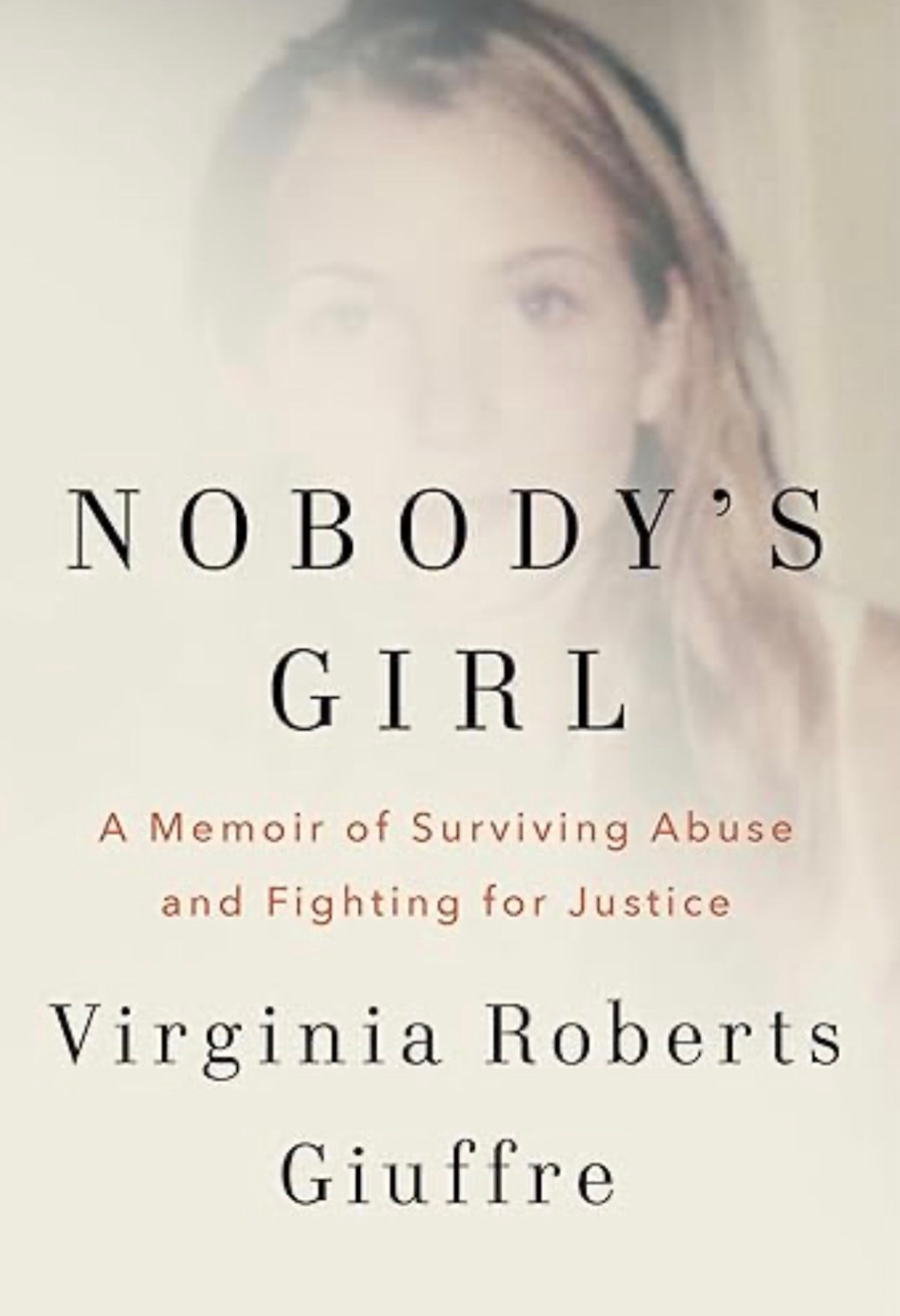
Nobody’s Girl. Virginia Roberts Giuffre

I’m writing this review the morning after the news broke the Prince Andrew has lost his royal title and has been removed from his Royal home.

And I have to say that this is the side of the story I brought this book to read more about. I don’t do gossip columns and I tend not to take much notice of what the Royal Family are doing, but Andrew’s behaviour has intrigued me over the last few years.

But I got so much more from this book, and it’s left me feeling conflicted

Virginia Roberts Guiffre is undoubtedly a victim and tells gives her account of her life of abuse in a no holds barred manner.

Abused by her dad and a neighbour, raped by two boys, rapped by another older man and abusing drugs and alcohol before she even left school. At this point I see her clearly as a victim.

She’s uncertain of her age when she first encounter Ghislaine Maxwell, who recruited her as a masseuse for Jeffery Epstein. Throughout the book she seems to think she was 15 but towards the end she agrees that she was probably 16, either way moralistically what happened to her is wrong.

But from that first encounter she shows little or no resistance to what happened to her. She was paid and walked away, only to return the next day.

Yes she was influenced by a very manipulative couple, yes she was used for sex by both of them.

Later in the book she describes how she was asked to perform the same “services” for other men, all of them much older than her, many of them rich and influential.

She also describes the lavish life style that Epstein and Maxwell lived. The mansions, the private planes, the Caribbean Island.

But she also describes walking freely around these places and the cities the mansions stood in.

She states she always carried a disposable camera and documented her travels, some of the pictures used in the book are from these cameras, as is the infamous Prince Andrew image.

Some of pictures seem like family snapshots.

She describes how she went from being used for sexual services to recruiting new girls for Epstein pleasure. Stating that she knew these girls were either underage or barely of legal age for sex.

She states she knew the nightmare she was leading these girls into.

When she finally makes her escape, on a trip to Thailand where she was training to be a qualified masseuse paid for by Epstein, she met her husband, and this is where she starts to rebel and fight back against the couple who have had such a strong hold over her.

She talks of starting a family in Australia, during which time she becomes aware that Epstein is being investigated. It is then that she starts to look for her own justice.

This is where a brave young woman emerges. A woman with strength and tenacity which is so contrary to the late teenage, early twenties woman she describes earlier in the book.

She is a tower of strength that, although well recompensed financially, only seems to want to bring her abusers to justice and see them in prison where they cannot hurt any more young girls.

So why am I conflicted.

I am full of sympathy for Virgina the young girl who was raped by her father, a family friend, two young local boys and another man before she was sixteen.

I found myself doubting her innocence and naivety’s during her early time with Epstein and Maxwell.

I started to think of her as complicit when she started to recruit new girls to Epstein world, and take part in sexual activities with them.

In fact some of the people that have since been prosecuted, or investigated about crimes committed with, and alongside, Epstein and Maxwell, only did what Virginia did, before and after her arrival in Epstein’s orbit.

During this period I can’t say I felt empathy with her.

But when she starts her legal battles she is a tour de force. Brave does not begin to describe her. The intimidation she suffers would have had most people running for the hills but she stayed strong, and was determined to see justice.

So yes my feelings for her are conflicted. Is it a middle aged man’s point of view. My daughter has just started the book, I’m going to be interested in her thoughts.

The one big thing that I have taken way from this book is a thirst to find out more about Epstein and Maxwells empire. The influence that they had over high society, politicians, major business leaders, law makers and a Royal Family member across the world.

How did the college drop out Epstein fund his lavish life style with and estimated wealth of half a billion dollars, as reported in the book.

How did he end up having such an influence over such highly respected, and important people.

Was Maxwell an equal, or was she actually the driving force in the relationship.

This book is a tough read in places, and it has got material that could act as triggers to people who have suffered abuse, but it is a book that had me held tightly in its grip, leaving me with a lot more questions than I had before I started reading it.

Pages: 367. Publisher: Doubleday

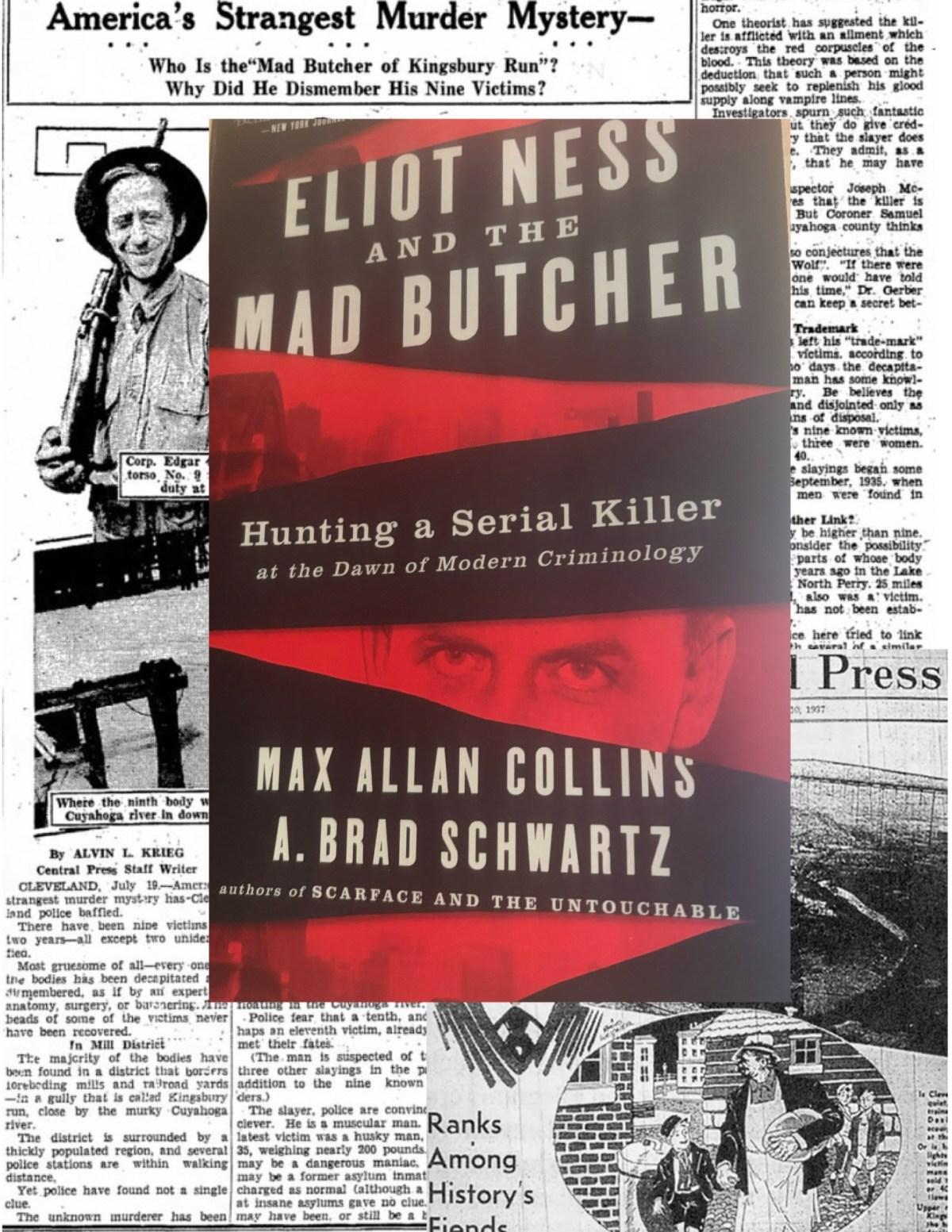
Eliot Ness and the Mad Butcher. Max Allan Collins. A. Brad Schwartz

An impulse buy on a quick trip to Waterstones ended up with me reading this true crime book which reads like a crime novel

The subtitle on the cover, Hunting a serial killer at the dawn of modern criminology, understates the impact that Ness had on crime fighting.

Eliot Ness is more famously known for his involvement in cracking the Chicago gangs during prohibition, and his pursuing of Al Capone.

In this book the authors look at what happens to Ness after Capone was jailed for tax evasion.

Ness moved to Cleveland and was appointed Safety Director where he took on corrupt police officers and unionists in equal measure.

He introduced the precinct concept of policing and started to utilise radio cars in the first known patrol area scheme.

He drove down the increasingly dangerous amount of drink drive incidents which had seen the first real surge in traffic accident road deaths.

But for all the praise he was getting there was one crime that was being used as a stick to beat him.

Just before Ness arrived in Cleveland body parts, of unidentified murder victims, started to be found in a run down area.

Although Ness was not a cop, he was responsible for the Police department, and people wanted him to turn his attentions to what was to be one of the first serial killers identified in the USA.

The victims all appeared to be from the homeless communities of an area called Kingsbury Run.

Over the following years numerous bodies, or parts of them were found, all appeared to have been killed by beheading, before being cut apart. Often the body would be found over several days or weeks, sometimes not all of the body was found.

The detective in charge of the case thought he had found the killer, but he was wrong, on more than one occasion.

Secretly Ness was working the case. He had employed his tactics from Chicago and put a team of unknowns together.

The Unknowns were made up of recruits who went straight undercover. They infiltrated everywhere the killer was thought to be hanging out.

Ness identified the man he thought was the killer. An alcoholic, failed doctor and pieced together the case against him.

A case that was never to get to court.

A case that Ness, near the end of his life, stated he had solved.

He also mentioned that there is more than one way to get justice.

The killings did stop whilst Ness was in position as Cleveland’s Safety Director.

Did he get his man.

The case is laid out in this book.

Publisher Harper Collins. Paperback print length 559 pages*

*395 pages are the main text. The remaining pages are lists of references and afterwords*

Every Contact Leaves a Trace. Jo Ward

I don’t know about Locard’s “Every Contact Leaves a Trace”, every contact with this book will certainly leave an impression, and a big one.

Jo Ward is one of the UK’s top Police Forensic Practitioners. Working in the West Midlands there is no end to the types of crime and levels of violence she has encountered.

This book is a brutally honest memoir of not only some of Jo’s landmark crimes, the ones that really sit in the front of the memory, but also on the mental and physical toll it took on her body and mind.

She starts by describing the shy, sports obsessed teenager that grew up in Halesowen, and takes the reader on a roller coaster journey of emotions of her trying to find her place.

Like most people who are good at their job, Jo is obsessively dedicated, and from before she even became a Crime Scene Investigator she ensured that she was ready for the job. let’s face it not everybody would visit a morgue and watch a Post Mortem just to make sure they could handle being around dead bodies.

Once in post she describes her journey via the incidents she remembers. For those of us living in the West Midlands most of them will trigger a memory. For those outside the area there are some that made national news., all of them are intriguing.

All of them are described in a deep manner, no holds are barred. The narrative takes the reader straight to the scene and makes it easy to picture.

The uniqueness of this book is that we also go inside Jo’s mind. Other books have looked at the thought process the Investigator goes through, but this book goes one step further.

That is where the brutal honesty comes in. This is where she looks at the psychological effect that the incidents are having on her.

It doesn’t end there.

Carrying on with the “no filters” honesty she looks at how the build up, and gradual over exposure to some of the most horrific incidents, led to her being diagnosed with PTSD. She talks about the incident which was the straw that broke the camels back.

She talks about how she deals with it, and is still dealing with it.

The impact her work has had on her family is covered it’s equal honesty.

She also looks at the way the investigation of crime is changing. The cutting back of officers, and forensic teams has led to an even deeper exposure. Less personnel covering more of the worst incidents.

The pressure of keeping up with all of the advances in forensic science.

Most cases that reach the court see a big reliance on the Forensic evidence. Jo takes us to one of these hearings and shows he pressure of being the witness under cross examination.

I was thinking as I was reading this book that it should be a book every True Crime, and Crime Fiction reader should read, but I’d go beyond that. I’d say it’s a book everybody who writes about crime should read. Whether it’s factual or fiction, if you want to know what it’s really like to be a Crime Scene Investigator you have to read this book.

More importantly, if you ever aspire to working in this field, and want to know what it’s really like, this is quite simply a must read.

Quite simply one of the best memoirs I’ve ever read.

Pages: 221. Publisher: Aurum. Audiobook length: 7 hours 18 minutes. Narrator Sarah Thom

I am not Nicholas. Podcast

When one of the most respected Police Officers I know of recommends a true crime Podcast it has to be worth having a listen. So thank you Colin Sutton, I took heed, and this is why I think it’s the best podcast I’ve listened to.

Jane MacSorely is an award winning TV Producer who worked for the BBC, but is now a freelance investigative journalist based in Scotland.

This podcast follows her investigation into the case of a man facing extradition, from the UK back to the United States, where he is wanted by the police on Rape charges.

The problem is the man in the UK has a different name, and claims he is not the man wanted by the American Police.

MacSorely wants to get to the bottom of this. Is it a case of mistaken identity by the authorities, or is the man weaving an elaborate web of lies to escape justice?

A little more about the case shortly but first a bit about how it’s presented.

As well as being a true crime investigation it’s just as much about the investigator. Jane MacSorely takes us on a ride from the start of her intrigue into the case, all the way to her conclusion.

The podcast is presented in almost a diary form. Her recordings are amazing. We hear her change her mind, we hear her frustrations, she live records her reactions to breaking news, she tells us how she feels following interviews.

It is a real eye opener for those who have never been involved in an investigation.

Me. I am a Fire Investigator, I have been involved in quiet a few criminal investigations, and I can empathise with MacSorely’s feelings throughout this podcast. And I never thought I’d say that about a journalist.

As an investigator you constantly build hypothesis. You use the “scientific method” to test the hypothesis. If it’s robust you consider it. If it isn’t you disregard it. This might take seconds in your own head, or it might take days, or weeks, of research, but it has to be done, and it will, and should, lead to you changing your mind, until you reach the right conclusion.

MacSorely does this in public, out loud, in the nine episodes of this podcast. At times she believes the man is who he says he is, and at times she thinks he’s the man the Americans say he is. What she doesn’t do is let any cognitive bias she may develop, in either belief, get in the way of her finding the truth. As much as she may want him to be Nicholas, or as much as she may want him to be Arthur, what she really wants is to know the TRUTH.

So who is Nicholas, and who is Arthur.

Nicholas is an American man. When he was young he portrayed himself as being a high achiever in the political world, working for politicians from a ridiculously young age.

He was a child placed into care, where he alleges he was abused.

He is a massive self publicist and sees himself as an important person, seeking an almost celebrity status.

Then he is accused of abusing somebody and receives a criminal conviction.

Shortly after that he announces he has advanced cancer and disappears from public view until his death is reported and his and his “wife” starts to try and arrange a public memorial service for him.

The American Police say he has faked his own death and that he has fled the Country.

Arthur is an unwell man. He has suffered badly with Covid and presents as a weak individual confined to a wheelchair and constantly wearing an oxygen mask.

The first encounter with him is following his release from prison where he was being held as a suspected American fugitive awaiting deportation. It was this trial that first attracted Jane MacSorley to the case. He’s out of incarceration but still faces a court battle to prove he is Arthur and not Nicholas.

He is short tempered and manipulative. At times I believed his story, much like MacSorley, and again just like her, I swayed the other way.

There is evidence presented in this podcast that, at first I found spurious, but which later became relevant.

At best the evidence presented in the podcast, and from what I’ve read in the actual Court Trials, is circumstantial, but there’s a lot of it.

There are obvious questions I, and most people would want to ask, which don’t get asked.

Why was no DNA test made. If they don’t have Nicholas’s on file, which I presume they would have as he has convictions in the States, they have close relatives which could have provided samples for familial comparison.

Arthur was being held for deportation before his release on licence, surely his DNA is also on record.

There are numerous images and videos of Nicholas when he was active in America, and although Arthur disguises his face with the oxygen mask and a beard, comparisons could have been made. MacSorely comes close to this with a short glimpsed observation of him without his mask, but no official image comparisons are recorded.

I don’t recall MacSorely digging into the life history of Arthur in the Podcast. Birth Certificate, School records, employment history, even social media history could all have been looked for or into.

A man cannot just appear in 2020 with no past. Yes it’s relatively easy to create a new identity, but it wouldn’t pass a proper scrutiny. Maybe it was done but either didn’t show anything up or didn’t support the narrative, but it should have been mentioned.

Having said that she does an excellent job of finding out the truth. In fact she obtains a piece of evidence that I’m not sure the law agencies dealing with the case found.

The ninth episode brings us right up to date at the time the podcast was released. With the one of the latest court hearing and it’s findings. No spoilers but I was straight on to google to research the outcome and it’s ramifications.

Jane MacSorely has taken this story as far as it could go…….so far.

Why so far? I’ve just seen a few articles that have reported Nicholas/Arthur’s latest Court appearance in mid February 2023. Safe to say this story still has legs.

Available in 9 episodes of varying length.

Available on Audible

Commissioned by the BBC

Narrated by Jane MacSorely.

Murder in the Neighborhood Ellen J Green

In 1949 a young man cracked. He had brought a machete and planned to cut his neighbours heads off, but because that took planning he had time to think about it and something inside him stopped him.

Then, on Labour Day he picked up a gun and went on a twenty minute walk down the street killing people that annoyed him over the years. Some others, a young boy, a man driving his car, we’re just in the wrong place at the wrong time.

In the end thirteen people lay dead.

The police knew who had done it and made a very quick arrest.

Howard Unruh was a bookish introvert who nobody though of as a threat. What made him flip, the vandalism of a back gate.

This is the story of that day, and the decades that followed. Researched deeply in the community.

Told through the story of survivors and people from the neighbourhood.

I had never heard of Unruh until I picked this book up. The first thing I did was hit Google.

He is thought by many to be Americas first “Mass Shooter” the first to pick up weapons and go on a shooting spree.

So why had I never heard of him. I’m a true crime fan. You would have thought he would have cropped up in my reading, or I’d have seen a TV documentary about the killings.

I think that is what I enjoyed so much about this book. I was new to this crime. Ellen J Green has done a marvellous job of tying together accounts and information from people who were there on the day or who knew the perpetrator and, or, his victims.

Most poignantly the accounts of Raymond, a young boy who witnessed the shootings and how he was affected by them. But most of all Unruh’s mother, who was left living in the small community he had wrecked havoc in, and how she had to live with his actions.

What drove a former model soldier, who had served in the later part of WWII, a man known for his love of the Bible to become Americas first mass shooter.

He was diagnosed to have severe mental health issues, but up until the shooting there doesn’t seem to be much of a worry about him.

He spent the rest of his life in a Maximum Security Hospital.

Did he get away with something there, was he as badly affected by mental health issues as he was diagnosed with.

I’ll let you decide.

Print length: 311 pages. Publisher: Thread. Publishing date: April 28th 2022

American Sherlock. Kate Winkler Dawson

I had heard of Edward Oscar Heinrich, but in somewhat of an urban myth type of way.

I knew he was a real person, and his name seemed to crop up on the edges of research I had done whilst gaining Forensic Qualifications.

So when I saw this book was available to review I knew I was going to read it. Originally I was going to use it as a literacy pallet cleanser, reading a chapter between books. That went out of the window after the first chapter

If you don’t know who Edward Oscar Heinrich is imagine a mad Professor who approached the Police and said science can solve crimes. Now think this happened in the early 1930’s

A lot of his work has gone unrecorded for years, after some of his methods were called into doubt.

But after his death in 1953, at the age of 72, all of his files and equipment went into storage. In the late 1960s the collection was bequeathed to the University of California where it lay untouched for nearly 50 years until the author requested permission to look inside the boxes, and what a treasure chest she opened

Heinrich was integral in some of the most high profile cases of the 20’s, 30s and 40’s

The first case that brought him to attention was when he assisted police in Portland with a crime that had gone wrong. 3 men had tried to stop a train and rob it, a bit like the UK’s Great Train Robbery, only this one went very wrong

The men only succeeded in blowing the train up and killing 4 people.

Heinrich used science to establish what had happened and helped catch the perpetrators.

And so was born Forensic Scene Examination, and Forensic Science in American Law enforcement.

This book looks at some of his more notable, and in some cases infamous, cases.

This is more than a book, it’s a gateway, via Google, into some brilliant reading.

Whether you are a True Crime fan, a Crime Fiction fan, or just somebody who enjoys a good book, you will live this.

But be prepared, it’s going to lead to a lot of reading outside of the covers of this book.

Pages: 359. Publisher U.K: Icon Books. Available now

Boots in the Ashes. Cynthia Beebe

Boots in the Ashes. Cynthia Beebe

A few weeks ago I saw a post on twitter announcing the publication date of a book, Boots in Ashes. Given my 30 years in the Fire Service this caught my attention straight away. When I dug around a bit and found that it was a memoir of an ATF Special Agent, who specialised in Fire and Explosion investigation, the discipline I specialised in for the last 12 of those 30 years, I knew it was a book I wanted to read.

Thankfully I managed to contact the author, Cynthia Beebe, and she helped me get my hands on a copy. That in itself must have been brave, after all she was going to let a subject matter expert review her book. Well I’m glad she did because this is a fantastic read.

Cynthia plots the course of her career by looking at some of the landmark cases she worked on, and some of the experiences she had whilst serving as a Special Agent in the ATF

The cases include the bombing of two Judges homes, targeted “Hits”, and her pursuit of Hells Angel type biker gangs. The book took me longer than usual to read because every time she mentioned a case I reached for Google and got lost in a worm hole of reports and witness accounts. This added a depth to the book, and in fairness each of these stories could have been a true crime book on its own. I hope that there will be another book where we get to hear about some more of her work.

It’s not just the cases though, it’s the way she describes the scenes. That first time she attended a Fire Scene and the confusion she felt at the destruction of the building which had been ravaged by fire. The determination she had to ensure that justice was done and that the culprit was found and taken to court.

The frustrations of working with, what a times were bigoted old men, makes Cynthia’s achievements even more impressive. When I teach University students one of the most often asked questions, by the young women in the class, is can women make good firefighters. My answer is always the same. Some of the best firefighters I ever served with were women. All of the worst firefighters I ever served with were men. Hopefully the question will stop one day but until then I’m going to point those who ask it in the direction of this book.

This book will be a great read for anybody who is into true crime, but I think there will be a lot of Fire Investigators and Crime Scene Investigators in the UK that will be looking for a copy, and they are going to love it

Published in the UK on 25the February 2020 and available on Amazon

MANHUNT Colin Sutton

IMG_3030

Over the last few months I’ve spent a lot of time traveling for work and have started to listen to audio books. Not the usual fiction I love reading, but real life accounts and memoirs.

A few months ago, a TV series caught my eye, Manhunt staring Martin Clunes. The true story based on the book MANHUNT, the memoir of Retired Detective Chief Inspector, and Senior Investigating Officer, Colin Sutton.

Having watched, and enjoyed the series, I went onto Amazon to look for the book, but it also gave me the opportunity to use a credit to buy the audio book. It was one of the best decisions I’ve made so far this year to download the audio to my iPhone.

The file is just over 9 hours long and is narrated by the brilliant Peter Noble, the perfect person to give Sutton a voice.

The account starts with an early memory from Sutton about why he became a Police Officer. Heading for life in Criminal Law he was sat doing work experience with Defence Counsel. Although every criminal has a right to a defence, Sutton quickly realised this is something he could not do. In fact, he decided he wanted to get justice for all of the victims of crime and decided against a, probably more lucrative, carrier in Law and decided to join the Police.

The story then jumps to the point where he returns to the Met as DCI of one of the Major Crime Teams having spent some time in Shire forces.

One of the first cases he picks up is a murder. A woman is found battered to death in Twickenham. She is quickly identified as the French woman Amelie Delagrande.

That is the starting point to one of the biggest criminal investigations the Met has carried out.

DCI Colin Sutton, acting as SIO, directs his team in an investigation which leads him to link the murder to that of Marsh McDonnell.

Once that link was made Sutton began to think that there may be other murders that were also linked and recorded an action for his team to look into any unsolved serious assaults and murders that fitted the pattern.

Suttons tenacity to detail found him some critics in the force, and maybe in his own team, in that he will leave no stone unturned and run down every possible piece of evidence. It was this tenacity that led to the breakthrough in the case though. The insistence that every piece of CCTV be found and watched, the insistence that every vehicle in the are caught on CCTV be identified.

More crimes started to come to light which may have been connected to the murder of Amelie, and one of the crimes in particular allows the story of one of the bravest victims of crime I have ever heard of being recounted.

Kate Sheedy was knocked over by a vehicle which then stopped and reversed over her. Her injuries were horrific, but it didn’t stop her phoning for help, give good factual evidence to the Police, and ultimately give evidence in court about the man who was eventually charged with the murders of Amelie and Marsha, and the attack on herself.

The man was Levi Bellfield, a man who is more notoriously remembered for killing Milly Dowler.

Colin Sutton recounts the story of his team’s investigation into the murder of Amelie and how it spread to incorporate many other serious crimes. It shows the working life of a detective working a serious crime, the sacrifices that have to be given, the emotions it evokes and the damage that can do to people and relationships professional and personal.

It lays bare Suttons though processes, which at times, although logical, must have been frustrating to some that worked with him.

It shows the all consuming effect investigating a serious crime can have on people, and in this case the serious crimes just kept mounting up the more they looked.

Once they had identified Bellfield, they were certain they had their man but did not have enough evidence to arrest him. One section of the book looks at how they put him under surveillance but the questions was for how long, and what happened if he committed a crime whilst they were watching him. Intervein in its early stages and show their hand before they had enough to charge him on all of the other crimes? What a decision to have to make.

This is not a spoiler because we all know what happened to Bellfield so I can talk about it. The worries and concerns about getting information and further evidence following his arrest. Interviewing him in a way that they can out wordsmith him and trap him in his own words.

The worry of the SIO, and his team, about taking evidence to the Crown Prosecution Service to see if they could proceed with one, some, or all of the crimes they want to charge Bellfield with.

Ultimately the trials and tribulations, the emotional rollercoaster of the trial. Years of work put in front of a Judge, and Twelve people from the “Clapham Omnibus”, and waiting to see if you have done enough to get the conviction that you know you deserve because, without doubt, this man is guilty.

What did surprise me was how Collin Sutton Felt after the trial. Not immediately because he felt the pride and joy that anybody in his position would have felt, but in the months afterwards with a few years left till retirement.

This is not just the story of Collin Sutton. It is a true reflection of his character that he includes many people in his memoir, some for outstanding praise, some for criticism.

He has no hesitation in showing admiration for his team, his peers, even if sometimes some drove him to distraction. He heaps praise on some witnesses, on the remarkable mother and father of Amelie, and shows his admiration of Kate Sheedy and her bravery in giving evidence.

He relates his frustrations at some previous investigations, that if carried out properly may have led to Bellfield being identified and arrested much earlier. He does not hold back at showing us his thoughts and frustrations with some Senior Officers within the Met and other forces. The fact that Bellfield was eventually convicted of the murder of Milly Dowling was more down to Sutton and his team than the actual SIO investigating her murder.

What he does is tell the truth, no filters, just the truth.

For those of us living in the naive belief that this country doesn’t have a problem with serial killers, “that’s an American thing” is something I often hear opined. This book will introduce you to one that terrorised London and the home counties for years. It was just that, until Colin Sutton came along, no one realised there was a serial killer on the loose.

The crimes that he committed, and that are laid out in this book, are unfathomable to most.

Unfortunately they won’t  come as a surprise to those working in the Police and some of their partner agencies.

This book hooked me for many reasons. Not least in how any things I empathised with. Like Colin Sutton I won’t work for a defence team, I have been asked many times but always politely turned them down.

As an expert witness I have sat in Court with Prosecution teams and seen the torment they go through during a trial.

I have stood on the stand giving evidence and felt the eyes of the defendant boring into me during murder trails.

I have never seen those feelings so well recounted as they are in this book.

This is the story of a criminal investigation into one of England’s most notorious killers. But it is so much more than that.

It’s the story of the man who shouldered the burden of responsibility in a professional and personal manner.

It’s the story of the victims and their suffering

It’s the story of a Monster Amongst Us.

It is a fantastic listen as an audio book, and soon the book will sit amongst my reference books in my office.

56 The Story of the Bradford Fire Martin Fletcher

56 The Story of the Bradford Fire

Martin Fletcher

bradford fire

Those of you that know a bit about me will know that I have more than a passing knowledge of fires and fire investigation, so when you read this blog you will know that it also comes with a healthy degree of expertise and knowledge.

I picked the book up last week and had read it within 48 hours, then I read it again over 3 or 4 days, just to make sure I hadn’t misread anything. This is without doubt one of the best accounts of a fire, as seen from a victims point of view, and as a piece of investigative writing,  I have ever read. Martin Fletcher if ever we meet let me buy you a coffee.

The first half of the book is autobiographical. Martin writes about his life leading up to the incident in 1985, his experiences at the fire, and his life after the fire. He reminisces about the family members he lost on the day, about decisions and actions he took on the day which ultimately led to his survival, and the grieving process he is still going through. Later in the book he mentions, fleetingly, that he suffers from PTSD but at no time in the book does he come across as self- pitying, or that he is looking for anybody’s empathy.  The second half of the book looks at his need to find out all of the facts about the fire. His mother was never happy with the outcome of the investigations surrounding the fire and subsequent Inquiry Chaired by Mr Justice Popplewell. Fletcher was too young at the time of the fire to realise what she was saying. As he grew older he began to understand her concerns. He heard story’s, and remembered remarks his father had made, about other fires in buildings belonging to the same man who owned Valley Parade at the time of the fire. He started to question the evidence given at the Inquiry when he noticed inconsistencies in the statements given by many of the people involved with the football club, the police on duty that day, and the expert fire investigators. He took months of his life to sit in research libraries to search out facts, and improve his understanding.

I have read in some newspapers that he is being berated for his campaign to have a new inquiry. I don’t see that. There is no malicious vendetta, there is no over exaggeration, there are no trumped up facts. It is a simple account laid out for all to see. Fletcher has taken facts and presented them in such a way that it should make it moralistically impossible for this incident not to be looked at again.

The book is written by a well-informed layman allowing anybody with an interest in this particular incident to read and understand the facts.  It is the remarkable story of a survivor of the incident and his troubled journey through his teens and young adulthood. It is the account of a man who is looking for answers, and to some extent finds them, but I don’t think it’s the end of his story just the first instalment.

I spent 30 years in the Fire Service, the final 12 as a specialist Fire Investigator. In 1985 fire investigation in this country was in its infancy. Some would say at that time most fire investigators were not much more than dust kickers. As a discipline and science, like all areas of forensic investigations, it has come on leaps and bounds. However there is a lot in this book that troubles me about the science, or lack of it, used in the testing of the investigators hypothesis as to the source of the ignition.

The book also raises concerns about the speed of the Inquiry, the fact that it commenced a few weeks after the fire and lasted for only a few days; where as other Inquiry’s into similar incidents, which happened pre and post the Bradford Fire, have taken years to come to fruition and months to be heard.  The fact that the Inquiry also embraced the investigation into another incident which happened on the same day, a riot in which a young boy died at Birmingham City Football Club, makes it seem more frivolous.

These days I lecture to students and professionals about fire investigation. I will recommend this book as essential reading and use it to set a project. That project will be entitled “How would you conduct this investigation if this incident happened today”. If the answer reflects the investigation which actually took place the student will fail.

As a little aside to this blog, and to explain why the Bradford Fire has always stuck in my memory let me tell you about what I was doing on the 11th of May 1985.

I was a fireman at Highgate Fire Station in the West Midlands. I can’t remember much about the morning; it would have been taken up by training and attending incidents like any other Saturday day shift.  At about 2.30 in the afternoon both of our appliances were mobilised to St Andrews, the home of Birmingham City Football Club, to a flare ignited in the stand. When we arrived we were met by Police Officers who told us there was a highly charged atmosphere in the ground and that the home fans had been fighting running battles, both inside and outside of the ground with the away team, Leeds United, fans. The officer asked us not to enter the ground as it might be inflammatory to the situation so our gaffer went in on his own to ensure there was no sign of a fire. He returned to the appliances and we drove back to the station.

Highgate Fire Station sits on top of a hill and from the mess room you could see St Andrews. Once the appliances were parked up back in the engine house we made our way up the stairs to the mess for a cup of tea. As we walked through the door the first thing we saw was the live pictures from Valley Parade showing the stand fully alight and people trying to escape. Everybody ran to the window to look at the Blues ground all of us thinking “what the hell did we leave behind”. Fortunately for us the fire was in another football ground.

As we sat transfixed by the images on the television we received another shout, “the bells went down” We were on our way back to St Andrews where a wall had collapsed during a riot that was taking place in and around the ground. This time when we arrived we had work to do, digging people out from under the rubble whilst the police tried to protect us from the missiles being hurled at us by so called football fans. This was the incident in which the young boy died and which made up the second half of the Popplewell Inquiry :-

I personally don’t  think much of that half either!!!