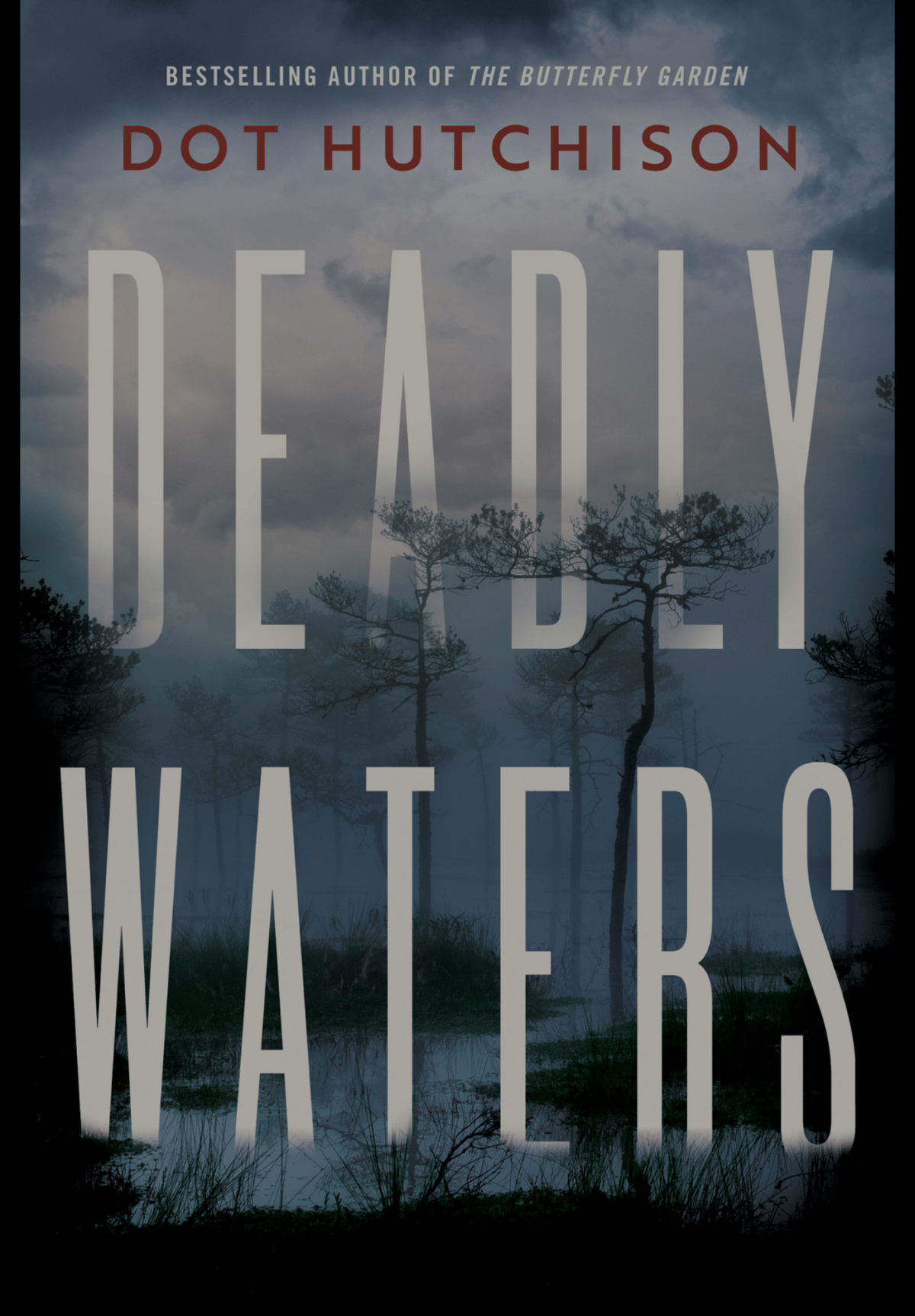
Deadly Waters. Dot Hutchison

Is it murder if as young woman picks up man to takes him back to her place. But on the way pulls into a rest stop, to let him pee, before tricking him into a nearby waterway and watching him get attacked by an alligator. Something she knew would happen, something she was banking on happening.

That is the way this book starts, and it’s absolutely gripping.

Set in a University in Florida the book looks at how some young men in Frat Houses take advantage of women as if it’s their right.

Not only do they seem to get away with it but they don’t even bother trying to hide their activities, in fact just the opposite they boast about it.

So when some of these men become the victim of alligator attacks is it a coincidence, or is it just bad luck.

Some Police Officers think it’s just bad luck, but some think that there is somebody getting revenge for the countless women abused by these men.

Rebecca is a criminology and journalist student and shares a University suite with a group of other girls.

Rebecca is the sensible one, the one who doesn’t drink, the one who thinks study is more important than partying.

Ellie is the polar opposite. A party girl who thinks studying just gets in the way of her nightlife life style.

Ellie has other problems, she likes to fight, she especially likes to fight the type of men who take advantage of the girls on campus. To exasperate the problem she’s also very vocal about her feelings, in particular she’s loud and proud about the fact that the men that are killed deserve what they got, and shes glad they got it.

Rebecca, and the other suite mates, try to keep Ellie out of trouble with the boys on campus and the Police investigating the deaths, but they are not always successful and Ellie manages to put herself clearly in the frame as the number one suspect.

This book is a brilliant look at crimes and victimology.

The girls who are abused are done so in the worst way, not only do they suffer the physical abuse but they then have to face the mental and emotional abuse as the men brag about their conquests and activities.

The usual defence of “they were asking for it” because of the way they were dressed, or because of the state they got into is at the heart of the story, and unfortunately it rings all to realistic.

But when the abusers become the victims, then things change.

Girls who should be seen as victims suddenly become the target of police inquires.

But as the male victims start to stack up, and as the police investigation is getting nowhere, the killer becomes a mythical street vigilante that the girls on the campus are cheering on, and even celebrating.

Things are changing. The Police need to find the killer but the students are making it difficult.

Rebecca and the other suite mates suspect Ellie is the killer, but shes their friend, and whoever is doing the killing is helping to keep the female students safe, so why should they report her.

In fact they find it hard to talk about it amongst themselves, they all have suspicions, but they all feel guilty sharing them.

Moralistically what would most people do in these circumstances. With no hard proof, just suspicions, would anybody accuse their friend of being a killer, who just also happens to be gaining local hero status, and in the process ridding the world of some scum.

Pages: 303. Publisher: Thomas & Mercer

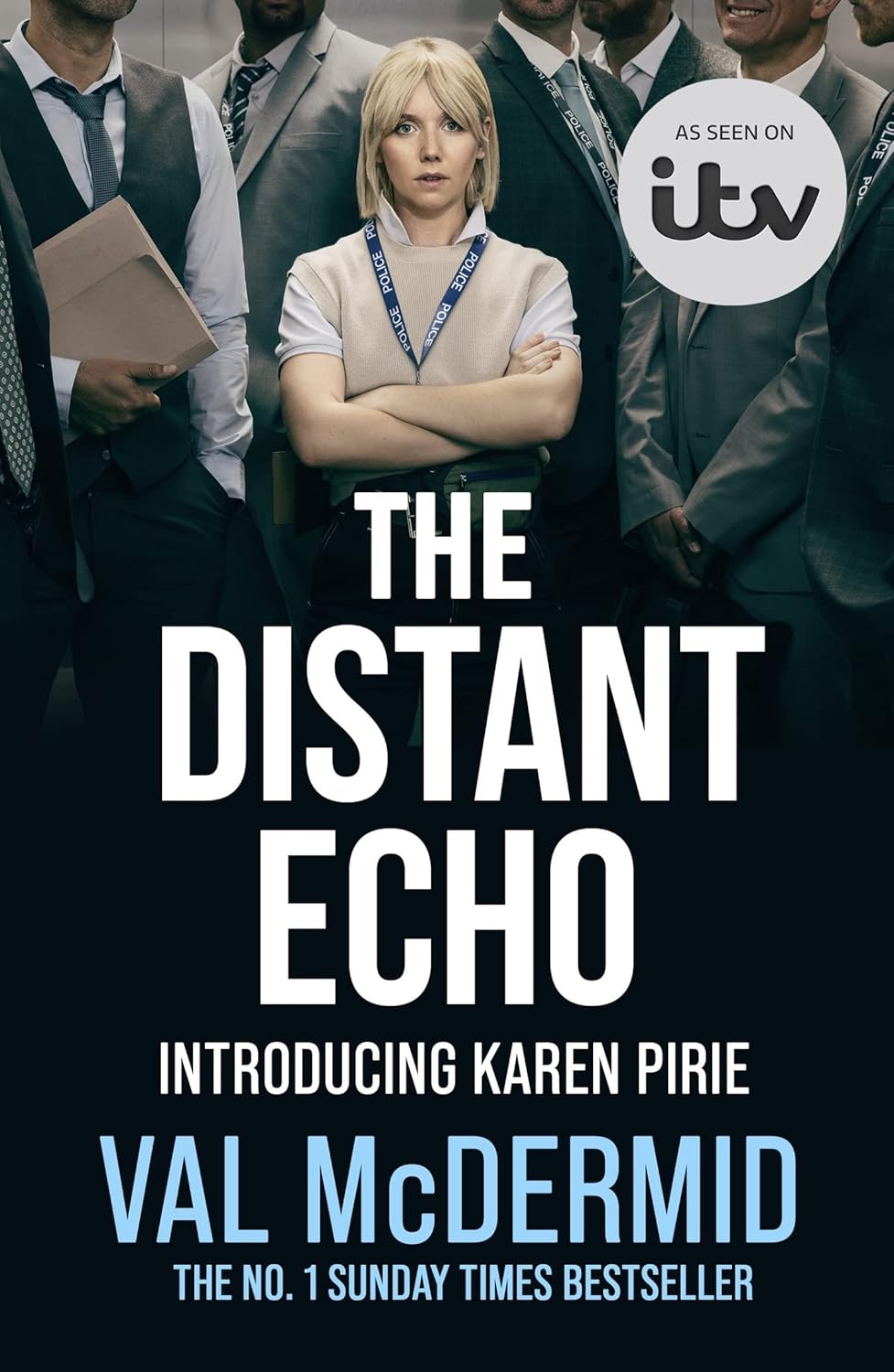
The Distant Echo. Val McDermid

Val McDermid was one of the first U.K. Crime writers I got hooked on, with her Tony Hill series, and for some reason she went off my radar.

I don’t usually buy books based on having watched a TV series, but when Karen Pirie appeared on our screens, even though I was late to the game, I decided to read the first book in the series, Distant Echo.

Why oh why did I stop reading this woman’s books.

Distant Echo

1978. What starts out as an innocent night out at University, for four friends, has an impact on the rest of their lives.

Walking home they find a young woman, Rosie Duff, who has been viciously attacked, bleeding in the snow. They try to help but she dies.

They instantly become the focus of the police investigation, and although only ever “considered” witness by the police, they are damned by public opinion.

When nobody is ever charged with the murder they are always considered the murderers who got away with it.

The four have been friends from childhood and each has their idiosyncrasies, and secrets.

The police become even more suspicious of the boys when they get caught trying to hide the fact that they’d borrowed a fellow students Land Rover, without his permission, on the night of the crime.

The story of the murder, and subsequent investigation takes up much of the first half of the book, and it’s an intriguing read.

The effects of one lie, the car. The test of the relationships between the boys as each begins to doubt one of the others story. They’d been to a house party on the night of the murder, and none of them can account for what they did for the entirety of the time they were there. Could one of them have sneaked out and attacked the girl, who they all knew, from the local pub.

2003. A cold case review team has been set up by the Police. The murder of Rosie Duff is one of the first investigations.

Science has moved forward, so examination of the evidence should help, but it’s gone missing.

The men, now in their forties are still considered by many as the chief suspects and have struggled to escape the rumours that they got away with murder.

Rosies brothers were free with their fists back in the 70’s and one of them hasn’t changed much.

But there’s somebody else out there holding a grudge, and the identity of the killer has never been established.

So when, around the 25th anniversary of the murder approaches, and the four find themselves under threat, and worse, is it somebody out for revenge, or is the real killer trying to stop any reinvestigation by getting rid of the main witnesses.

The second half of the book is addictive as the first.

I changed my opinion three or four times as to who the real killer of Rosie Duff was, but when it was finally revealed it was a real “doh” moment.

That person was on my radar but dismissed, but the reveal made real sense.

As always the book is so much better than the TV adaptation, but I’m glad I watched it to trigger my interest.

Val McDermid is firmly back on my reading list, and right up there with my favourite authors.

Pages: 577. Publisher: Hemlock Press

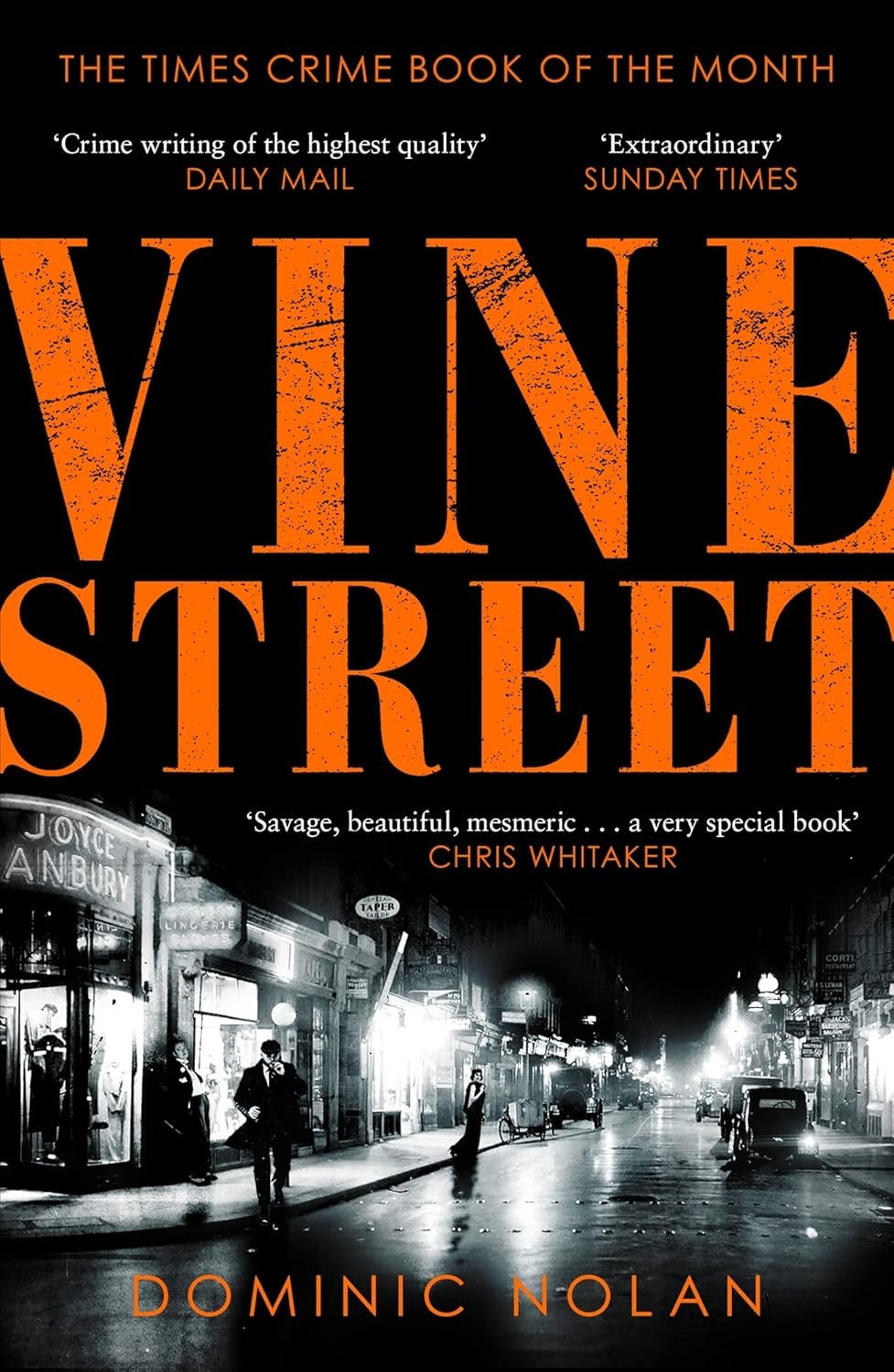
Vine Street. Dominic Nolan

A new author to me and I’m really excited to see he has other books already published.

Why?

Because I’ve just read the best British crime thriller I’ve ever read.

Reading is subjective, and not everyone has the same tastes, but for me this book ticked every box, and ticked them in style

Predominantly set from the mid 1930s up till just after the Second World War the story mixes fact with fiction.

Real events, and real people populate the story alongside the fiction.

The fact, in the 1930’s somebody was killing prostitutes in the red light area of Soho. Several murders were attributed to Soho Strangler, a case that was never solved.

These murders form the skeleton for the story in this book. When the first woman is found the Clubs and Vice Unit, known by the locals as “The Dirties” start an investigation.

Lead by DS Leon Geats the team are more known for keeping the girls and their pimps in line, and controlling the gangs running competing clubs which provide drugs and girls.

Geats knows the streets and the people who inhabit them, a proper old school, skull banging policeman.

When senior officers decide to allow the notorious Flying Squad, with their maverick leader Nutty Sharpe, to take over the investigation it only leads to conflict amongst the police, whilst the murder investigation merely trundles along.

Geats is tasked to partner up with one of the flying squad, DS Mark Cassar. The unlikely partnership begin to link several murders, much to the annoyance of Sharpe who is convinced he has his man, but the murders continue.

The murdered women, mainly prostitutes, are factual, as is the leader of the Sweeney. The rest is a cleverly woven, semi factual, brilliant story telling.

The lives of Geats and Cessar are consumed by finding the real killer, with the story moving, at times into the 1960s before finishing, where it started in 2002.

I love stories set in the recent past, with real life settings, where the fiction is knitted into real events and includes real people.

British readers might be familiar with the excellent Charles Holborn series by Simon Michael, and international readers will know of James Ellroy and his books set in 1940s onwards America.

Dominic Nolan is right up there in that category.

The historical events in the book had me disappearing into Google for hours. The story of the Soho Strangler is fascinating and the way Nolan has written it took me right into the heart of 1930s Soho and the police investigation.

Some of the periphery character also prove to be real life people. The Mitford Sister were socialites associated with Oswald Mosley and his Black Shirt fascists. In fact Unity Mitford was umpired to be a lover of Adolf Hitler.

Another few hours spent on Google educated me about them, and what a story that is.

All of the things we hear on the news about London, and other big cities, today were happening in the 1930s Soho.

People trafficking with women being sold into the sex trade. The women having to pay off the debt of the traffickers being forced into prostitution.

To make sure the debt was never paid getting the girls into drugs, which they had to sell their body to purchase.

All of these we think of as today’s problem. But in the 1930s there was another layer.

Some of these women were foreign agents acting for the German military, trying to infiltrate British society, and get access to British troops, and ultimate their knowledge of how Britain was preparing for war.

This all forms part of the story and adds real intrigue.

Who is the murderer, but almost more importantly who are some of the victims, they certainly aren’t who they seem to be.

And if that’s the case, are they just random prostitution who happen to have met the wrong man, or are they women working undercover who have been specifically targeted.

And just to add to all of this, the killer is a pervert with a liking for incapacitating and flogging his victims.

My next few reads are already loaded on my Kindle and it’s no surprise that they are written by Dominic Nolan.

Pages: 610. Publisher: Headline. Audiobook length 14 hours 13 minutes. Narrator Owen Findlay

My Brother’s Dominatrix

B.B Lamett.

Don’t be fooled by the title or the cover. This is not one of those spicy Fifty Shades of Grey type books. It’s a psychological thriller that explores the alternative sex scene through the eyes of a, as the book describes her, very vanilla woman.

Sarah is a middle aged teacher, married with son in university.

Who, whilst she is away with her husband, she receives the shocking news that Simon, her twin brother, has died suddenly.

She knew Simon had been struggling. Recently divorced he had gambling issues and had spent a lot of money in online chat rooms.

What she wasn’t prepared for was the apparent dive her brother had taken in to in the Brighton BDSM scene.

A lot of his antics are alluded to without going into gratuitous detail.

The other surprise is that he had changed his Will to leave everything to his dominatrix Angel.

The book describes Sarah’s journey of discovery whilst carrying out her role of executor of the Will.

Discovering the depths of his drug use, his gambling addiction and his use of Dominatrixes.

She finds that Angel was actually trying to help Simon by taking control of his finances, a fact that totally throws her off guard, as does the friendship she develops with her

Ultimately she just wants to find the truth about her brother, finish off her role as executor, and scatter his ashes.

What she actually does is find herself being pulled into the world he occupied. Becoming obsessed in her commitment to her brother she finds herself losing friends and family.

Where will the descent end, and will she succumb to some of the temptations that come her way.

For me this was a good quick read. The was no need to think too deeply about the plot. Thankfully it wasn’t one of those books that had me going to Google every few chapters. It was the very definition of bubblegum for the brain. A nice distraction.

Pages: 322. Publisher: Broodlero. Available on Kindle Unlimited

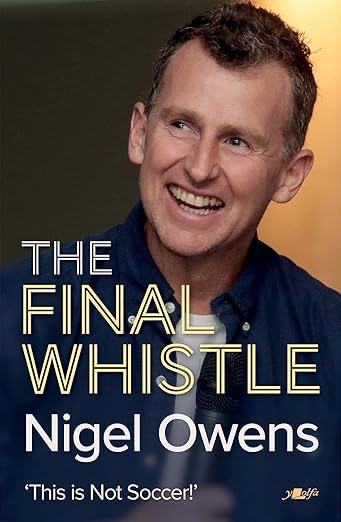
The Final Whistle. Nigel Owens

Before I start on the content of the book I’ve just got to comment on the quality of it.

It’s been a while since I held a book that was so aesthetically pleasing, and made of such good quality materials.

The paper quality is really nice, the text is printed in a lovely format, and the two sections of pictures are plentiful and have quality images.

I don’t think I’d realised how badly presented books have become until I picked up this quality product.

So what about the content.

I’ve been a fan of Nigel Owens for years, since well before his one liners and comeback responses started to go viral.

This is a second autobiography by Nigel, Halftime being the first. This book pretty much starts at the darkest time in his life. It’s no secret that he had attempted suicide, and that he’d been very nearly successful. In this book he lays out how he got to that point.

He also details the struggles he had with coming out. Announcing to the world that you are gay can be tough at any time, but within the world of professional sport, particularly one seen to be so alpha male macho, it must have been terrifying.

The reaction from the general population, and in particular the rugby fraternity was fantastic, apart from the odd moron.

The descriptions of some of the memorable moments in his career are an absolute must read for any sports fans.

It’s a measure of the man that he speaks as fondly of refereeing matches in his local Llanelli and District League, as much as he does of refereeing massive internationals between the top countries in the world.

His progress through officiating rugby games sees him taking charge of the World Cup Final in 2015 between New Zealand and Australia. The man with the best seat in the house gives a great account of this, and many other games, most rugby fans would have dreamed to have been in the crowd for.

His self analysis is humbling. Where many would have considered they had done a great job Nigel looks at the one or two decisions he, and his team of officials got wrong.

He’s at pains to point out that the one referee we see is not alone in running the game, touch judges, fourth officials and the TMO, all get credit, and the occasional tongue in cheek jibe. Step forward Wayne Barnes.

He talks about the isolation of the officiating teams during world cups, the elimination of the referees, not always being put down to their performance, but also the success of their home nation. A referee can’t officiate in a game in which their own country play, but also, and as a direct result of a championship he refereed in, they can’t officiate in a game that could have an influence on their home teams progression.

Imagine being the best in the world at what you do, but never been able to reach the pinnacle of your profession because you come from country that keeps getting to the World Cup final. I’m tempted here to say thank god Nigel Owens is Welsh, but as my wife is from Llanelli I might let that slide.

Perhaps the hardest thing to do when you enjoy the job you do, especially when you do it so well, is to know when to quit.

Nigel covers this in the later chapters of the book. A decision that was so nearly taken out of his hands. I recently heard another sportsman say that people at the top of their game are the first to know when they are losing that edge, that extra yard of speed, that extra ounce of strength, but they are the last to admit it.

Nigel seems to be the opposite to this. Towards the end of his career he was slowing down, even though he was in great physical shape. The trouble was rugby was changing, and even the pack were now, in the majority, becoming racing snakes built like brick outhouses.

He didn’t step back and think he couldn’t keep up. He sought help and changed the way he reffed the game. Took up different positions on the pitch, and extended his reign as one of, if not the top Rugby Union Referees right up till the end.

What did he do when he retired, not only is he running a farm with his partner, he has a media presence, and why not he has a great personality.

But the things he mentions right at the end of the book, almost as a few throwaway comments, about how he is helping the next generation of Welsh Rugby Officials will guarantee his legacy.

And whilst the rest of the WRU seems to be in disarray at least we will know the the future of the officiating is in good hands.

Max Boyce used to sing about the The Outside Half Factory buried in the Valleys of West Wales. With Nigel Owens on the production line I’m sure it’s about to reopen producing the men and women in the middle, giving us great match officials who can run a game with a smile on their faces whilst commanding full respect from the players and fans alike.

A brilliant read

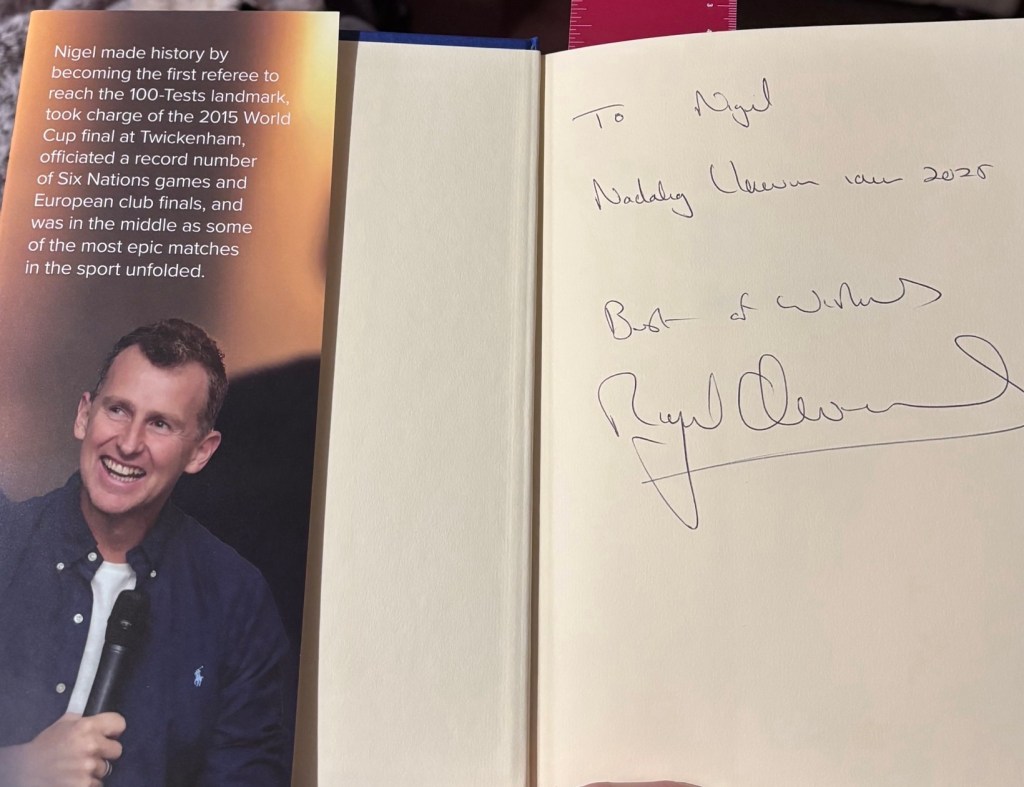
My wife got me this book for Christmas and Nigel had put an inscription inside the cover.

It will take pride of place amongst my growing collection of books with inscriptions.

Diolch yn fawr Nigel

The 12th Cleansing. N. Joseph Glass

I may have left on of the best reads of 2025 to one of the last reads of 2025.

N. Joseph Glass is a new name to me but one I will be watching out for.

The story is that of the investigation into the murder of Sandra Rawlings, an innocent 17 year old, church going girl.

A girl who it appears has been murdered by a serial killer who had previously killed eleven young girls, of a similar age, but having not been caught has laid dormant for four years. Is Sandra really the 12th victim of a man who killed girls who had either just lost their virginity, or are just about to.

The story is cleverly told via six main characters, all of which have equal billing. Each chapter has one of these characters at its centre but is not written in the first person.

Walker Michaels is the veteran senior detective who was the lead on the first series of murders. A middle age man with virtues and an ethos that are typical of his age and experience.

Brandon Jones, the junior detective on his first murder case. His youth and enthusiasm, along with his misplaced confidence and machismo getting him into trouble with his more experienced partner.

The other main characters are the immediate family of the dead girl.

Allen Rawlings, a hard working man who is a pastor in the local church. An oxymoron of a man he rules his own house with a sullen harsh hand. At the same time he is having an affair with a foxy single mother in his congregation.

His wife Sonya, the down trodden and at heal wife who outwardly defends her husband attitudes and actions, whilst secretly harbouring more liberal thoughts.

Their son, Connor, a typical moody teenage boy who spends most of his time on his computer shielded from the outside world by his headphones. His sisters death brings him closer to his mom and he starts to rebel against his dad.

There are peripheral characters that add to the investigation. The mysterious M, who it quickly become obvious is a killer.

Pete, one of the other Pastors and Charlotte, the single mother Allen Rawlings is having an affair with.

The plot is nicely written with a fast pace.

I like to think I’ve usually got an idea of who the killer is relatively early in a book, not this one.

And the reveal when it came, although surprising, wasn’t one of those unlikely or unrealistic reveals. It was perfectly in context, just really well hidden.

Pages: 404. Publishers: Monocle Books. Available on Kindle unlimited.

Mimik. Sebastian Fitzek

Adverts for this book kept appearing on my timelines, and after reading the gumph, and some reviews on Amazon I decided to give it a go.

I wasn’t disappointed, at first.

I read on a kindle so page numbers don’t really mean anything but at 85% into the book things started to go rapidly downhill.

The pretext of the book is that a woman, Hannah Herbst, has confessed to killing her family; her husband and their son, and her step daughter.

She is a consultant that works for the Police examining facial expressions and reading lie tells.

The problem is she cannot look at her own face in the mirror, scared of what she might see in her own personality.

It is a real problem when she wakes up with short term memory loss having suffered a self inflicted knife injury following the attack.

She’s been arrested and has made a full confession, on video.

The man showing her the video of her confession is also a serial killer, and he has taken Hannah hostage when he escaped.

All this might sound very confusing but it’s actually the backdrop to a really good story, up until that last 15% of the book.

It becomes evident quite early on that Hannah probably didn’t carry out the attack that left her husband and step daughter dead and her son missing presumed taken and killed.

But that last 15% basically shifts through every character named in the book being identified as the killer only for each hypothesis to be wiped out by the next.

Each is more fanciful than the previous and as a reader I was left giddy by the amount of twist and turns the last few chapters took.

I don’t do star rating but if I did, the first 85% would be a 5 star rating, the last 15% a generous two star.

Pages: 341. Publisher: Head of Zeus

Black Dog. Stephen Booth

Every now and then a TV series will hit the screens stating it’s based on the books of a best selling author.

If the series looks good I’ll try to read the book before watching the program, especially if I’ve never heard of the book series.

This was the case with the Copper and Fry series that recently started on Channel 5 (UK November 2025). The previews looked really good so I looked up the books. I was surprised I’d never heard of Stephen Booths books, there’s 18 in the series, and it’s my favourite genre.

Black Dog introduces DCs Ben Cooper and Diane Fry. Who police the Peak District.

Cooper is a local man. He is well respected and thought highly of by his peers and bosses, and is favourite to be promoted into the upcoming vacancy for a DS.

Fry is a fast track graduate who has just transferred from the West Midlands Police.

They are polar opposites in their professional approach, private lives, and attitudes.

Cooper is very much the local lad cop, he knows everybody and everybody knows him, the problem is many civilians only know him as his father’s son, a well respected Police Officer who died on duty.

And that really annoys him.

He has problems at home, his mother is suffering severe mental illness, and it’s taking its toll on him and his extended family, all of who live on the family farm.

Fry is battling her own problems, her and her sister had been in care since she was very young, her sister, already a drug addict, hasn’t been seen since she was sixteen.

Then there’s the reason she left the WMP, a dark secret she is desperate to keep from her new colleagues.

Set in 1999 the police are still plagued by old attitudes, especially towards fast tracked graduates, who have come from a Met force, and just happen to be young attractive females.

The story of the murder which is investigated in the book almost seems secondary to the setting the scenes of the two main characters and preparing the reader for what is to come.

For what it’s worth the murder is that of a young girl. The daughter of a couple that moved into a large house in the peaks. Rumours abound that orgies and sex parties are regular occurrences at the house.

Three old men, World War Two veterans are at the centre of the investigation. Arrogant doesn’t begin to describe these characters and they quickly become frustrations to the police, and the reader.

Fry and Cooper work together as DCs and in a way there is a begrudging respect beneath a simmering contempt. Expected a will they, won’t they, thread in the series.

I enjoyed the story and the characters, but, and for me it’s a big but, there is way too much spurious writing. As an example Fry leaves the Police Station after one of her first shifts, and goes straight home to her flat. That journey takes eight pages and contributes nothing to the story, and there are a lot of examples of that throughout the book.

There were times I found myself speed reading through five or six pages that held no relevant content.

Will I read more of the series. Yes, it will be one of those I dip into occasionally but it won’t be one I binge read.

Pages: 537. Publisher: Harper Collins

Relentless Pursuit. Our Battle with Jeffrey Epstein

Bradley J. Edwards with Brittany Henderson

My last review was Nobody’s Girl by Virginia Roberts Giuffre. I started that book because I was intrigued by the actions of the then Prince Andrew, who immediately after that book was published lost his Royal titles.

That book sent me down a rabbit hole of research. I had heard of Jeffrey Epstein, and was vaguely aware of the crimes he was ultimately arrested for. But I had no idea of the Epstein empire, the type of person he was, and the high level relationships he incubated, and the reach those relationships had.

As fascinating as Nobody’s Girl was it was a single persons account and I was desperate to find other accounts of Epstein’s activities.

Relentless Pursuit stood out. Written by two of the people that were involved in trying to prosecute Epstein and get him in prison.

Edwards, and the book, are mentioned by Giuffre in her book, and she was full of praise for his tenacity in prosecuting a man many people thought was untouchable. So what better place to start my extended reading.

In June 2008 Edwards was a young lawyer opening his first law firm. He had never heard of Jeffery Epstien. A young 20 year old woman, Courtney Wilde was referred to him by a friend. She stated she had been sexually abused by Epstien from the age of 14.

And so it began.

What follows is years of tenacity on Edwards’ side, and years of lies and deception on Epsteins.

As Edwards’ investigations gather momentum more witnesses start to come forward, one of which is Jane Doe 102, Virginia Roberts Giuffre. Although a star witness, and a person who does as much to bring down the Epstien empire as anybody, a person who Edwards finds himself admiring for her bravery in standing up, it’s very telling that his first emotion was excitement at getting one of “Epstiens inner circle” to testify against him.

That line in the book, the one of Epstiens Inner Circle, exhibits the depth of her involvement.

Epstien’s only defence is attack

In fact he attacked every lawyer, and every victim those lawyers represented with either lawsuits or intimidation tactics, and often both.

The sphere of Epstein’s influence is clearly displayed when he made a Plea Deal in 2008, which saw him serve a minor sentence, during which time he spent nearly every day in a charity foundation office next to the jail. A foundation he set up so that he could spend his days in relative comfort.

This deal saw him convicted of relatively minor crime but the deal he struck was a none prosecution deal for all of the major charges he could have been charged with, including sex trafficking and rapping underage girls.

The frustration Edwards and his team felt at this is palpable in the book. The only avenue they now had was civil suites.

But Epstein was in full attack mode. Edwards had been employed for a short time by a law firm whose director was found to be running one of the world’s biggest ponzie schemes, that’s a whole other story worth looking into.

Epstein accused Edwards of not only being involved in the scheme but also being the main orchestrator. A fact he knew from the start to be false.

This tied Edwards and his team up, distracting them for years.

All the time Edwards and Epstein had occasional off the record meetings in, of all places, a Starbucks coffee shop, no other lawyers or representatives being present. Edwards likens his dealings with Epstein as a complicated game of chess. During these meetings he relates how Epstein is cheerfully friendly, as if he is talking to a friend, but every meeting held an alluded to, or indirect threat that Edwards was going to be ruined professionally and financially, because he hadn’t got the resources or money that Epstein had available to him.

Neither did Edwards have judges, politicians, senators, and many other highly placed people in his pocket.

When the direct fight against Epstein seems impossible the team go after his close associates. In particular Ghislaine Maxwell.

Maxwells is as close to a girlfriend as you can associate with Epstein, but is also his chief recruiter. A woman that finds underage girls and cons them into sexual activities with Epstein, often taking part in the sessions and abusing the girls herself.

This is when the castle walls around Epstein start to crumble.

The accusations made against Maxwells opens the possibility of new charges against Epstein.

Still the civil cases continue, as does Epstien attacks in the victims and their lawyers.

Until the final day of reconning, the day of Epstien ultimate arrest and his eventual death in prison. Another story that needs reading into.

Throughout the book there are allusions to Epstien real status. Was her working for governments, American, Israel, or both, or more.

He was certainly protected at very high level in America and had such people as Bill Clinton amongst his closest associates.

Evidence is presented in the book suggesting the Epstein facilitated large a money transfers between America and Israel. A former Israeli Prime Minister is mentioned in this book as being one of his associates, and in Nobody’s girl Giuffre recounts being viciously assaulted by a foreign politician, it’s not hard to make the connections.

Why did Epstein get away with what he was getting away with for so long. This book establishes, with information that is now freely available, that he was above the law for a long time.

It also establishes connections between him and high ranking officials in America.

Was he working for governments, was he establishing dark routes for money transfers. It’s still all very vague and still really intriguing.

Will this be the last book I read on this subject. Certainly not.

What started for me as a passing interest in what “Randy Andy” had been up to has developed into a fascination about a very dark period in recent history.

This book, and the story it contains, reads like a Grisham thriller mixed in with a Clancy espionage book. But as fanciful as those two authors stories are, this is pure fact.

The link below is to my review of Nobody’s Girl. Whichever you read first the other compliments it.

https://nigeladamsbookworm.com/2025/10/31/nobodys-girl-virginia-roberts-giuffre/

Pages: 399. U.K. Publisher: Simon and Schuster.

Cop Hater. Ed McBain

I’ve recently been in a bit of a reading slump.

Modern crime fiction seems to be following an all too familiar formula with many of the stories being very samey.

I recently resorted to rereading one of James Elroy’s books, classic crime fiction set in the 1960s, and having enjoyed it and looked for inspiration on Amazon.

The name Ed McBain came up and I remembered people reading his books when I was on the ships in the late 70s. I don’t know why I never picked one up then.

I’m sort of glad I didn’t because now I’ve found a rich vane of new books to make my way through.

Cop Hater is the first in a very long series, of over 50 books in the 97th Precinct series set in the fictional city of Isola, which is very obviously New York.

Written and set in the mid 1950s it’s an excellent study of not only policing in that era, but also of how people lived, their styles and attitudes. The language used, the thoughts and behaviour are very much of that era.

The city is no stranger to serious crime but when the Detectives end up investigating the murder of one of their own no stone is going to be left unturned.

The way they pull in known criminals, and the quick back stories associated with each, are mesmerising.

A second detective is killed and some forensic evidence is left. The Criminologists, Crime Scientist of the day are the early forerunners of today’s Crime Scene Investigators, but have little proven science to help them.

Blood matched only by types, no national shoe database, finger prints sent to the FBI for analysis, and DNA is decades away, as is CCTV, and personal phone data which so much of today’s policing relies on.

So who is killing detectives, and why. There are some nice observations and twists in this plot. There is the still, and ever present, hinderance of the journalist trying to get the “scoop” on the story. The reliance of information from an informer, who I hope has numerous appearances during the series, an early Huggy Bear, type character.

But the big draw is the cast of police officers, their professional and personal lives giving great depth to each character.

One of my favourite tactics that writers employ is to kill of protagonists or main characters in series. It means that the reader is always on the edge of the seat, as no one is safe. McBain sets his stall out early and kept me right on the very edge of the seat.

I won’t be reading all fifty plus books in one binge, but much like Elroy, McBain’s stories are now going to be my default books when I’m looking for a good, no holds barred, original, none woke story to read.

Pages: 226. Publisher: Thomas & Mercer Included in Kindleunlimited