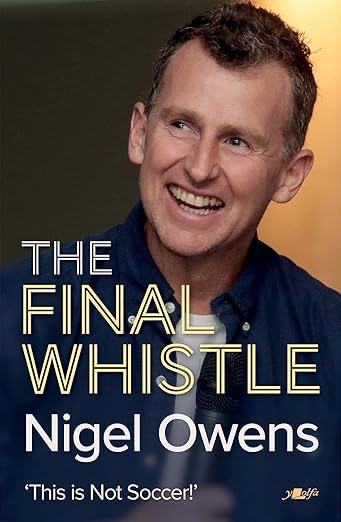
The Final Whistle. Nigel Owens

Before I start on the content of the book I’ve just got to comment on the quality of it.

It’s been a while since I held a book that was so aesthetically pleasing, and made of such good quality materials.

The paper quality is really nice, the text is printed in a lovely format, and the two sections of pictures are plentiful and have quality images.

I don’t think I’d realised how badly presented books have become until I picked up this quality product.

So what about the content.

I’ve been a fan of Nigel Owens for years, since well before his one liners and comeback responses started to go viral.

This is a second autobiography by Nigel, Halftime being the first. This book pretty much starts at the darkest time in his life. It’s no secret that he had attempted suicide, and that he’d been very nearly successful. In this book he lays out how he got to that point.

He also details the struggles he had with coming out. Announcing to the world that you are gay can be tough at any time, but within the world of professional sport, particularly one seen to be so alpha male macho, it must have been terrifying.

The reaction from the general population, and in particular the rugby fraternity was fantastic, apart from the odd moron.

The descriptions of some of the memorable moments in his career are an absolute must read for any sports fans.

It’s a measure of the man that he speaks as fondly of refereeing matches in his local Llanelli and District League, as much as he does of refereeing massive internationals between the top countries in the world.

His progress through officiating rugby games sees him taking charge of the World Cup Final in 2015 between New Zealand and Australia. The man with the best seat in the house gives a great account of this, and many other games, most rugby fans would have dreamed to have been in the crowd for.

His self analysis is humbling. Where many would have considered they had done a great job Nigel looks at the one or two decisions he, and his team of officials got wrong.

He’s at pains to point out that the one referee we see is not alone in running the game, touch judges, fourth officials and the TMO, all get credit, and the occasional tongue in cheek jibe. Step forward Wayne Barnes.

He talks about the isolation of the officiating teams during world cups, the elimination of the referees, not always being put down to their performance, but also the success of their home nation. A referee can’t officiate in a game in which their own country play, but also, and as a direct result of a championship he refereed in, they can’t officiate in a game that could have an influence on their home teams progression.

Imagine being the best in the world at what you do, but never been able to reach the pinnacle of your profession because you come from country that keeps getting to the World Cup final. I’m tempted here to say thank god Nigel Owens is Welsh, but as my wife is from Llanelli I might let that slide.

Perhaps the hardest thing to do when you enjoy the job you do, especially when you do it so well, is to know when to quit.

Nigel covers this in the later chapters of the book. A decision that was so nearly taken out of his hands. I recently heard another sportsman say that people at the top of their game are the first to know when they are losing that edge, that extra yard of speed, that extra ounce of strength, but they are the last to admit it.

Nigel seems to be the opposite to this. Towards the end of his career he was slowing down, even though he was in great physical shape. The trouble was rugby was changing, and even the pack were now, in the majority, becoming racing snakes built like brick outhouses.

He didn’t step back and think he couldn’t keep up. He sought help and changed the way he reffed the game. Took up different positions on the pitch, and extended his reign as one of, if not the top Rugby Union Referees right up till the end.

What did he do when he retired, not only is he running a farm with his partner, he has a media presence, and why not he has a great personality.

But the things he mentions right at the end of the book, almost as a few throwaway comments, about how he is helping the next generation of Welsh Rugby Officials will guarantee his legacy.

And whilst the rest of the WRU seems to be in disarray at least we will know the the future of the officiating is in good hands.

Max Boyce used to sing about the The Outside Half Factory buried in the Valleys of West Wales. With Nigel Owens on the production line I’m sure it’s about to reopen producing the men and women in the middle, giving us great match officials who can run a game with a smile on their faces whilst commanding full respect from the players and fans alike.

A brilliant read

My wife got me this book for Christmas and Nigel had put an inscription inside the cover.
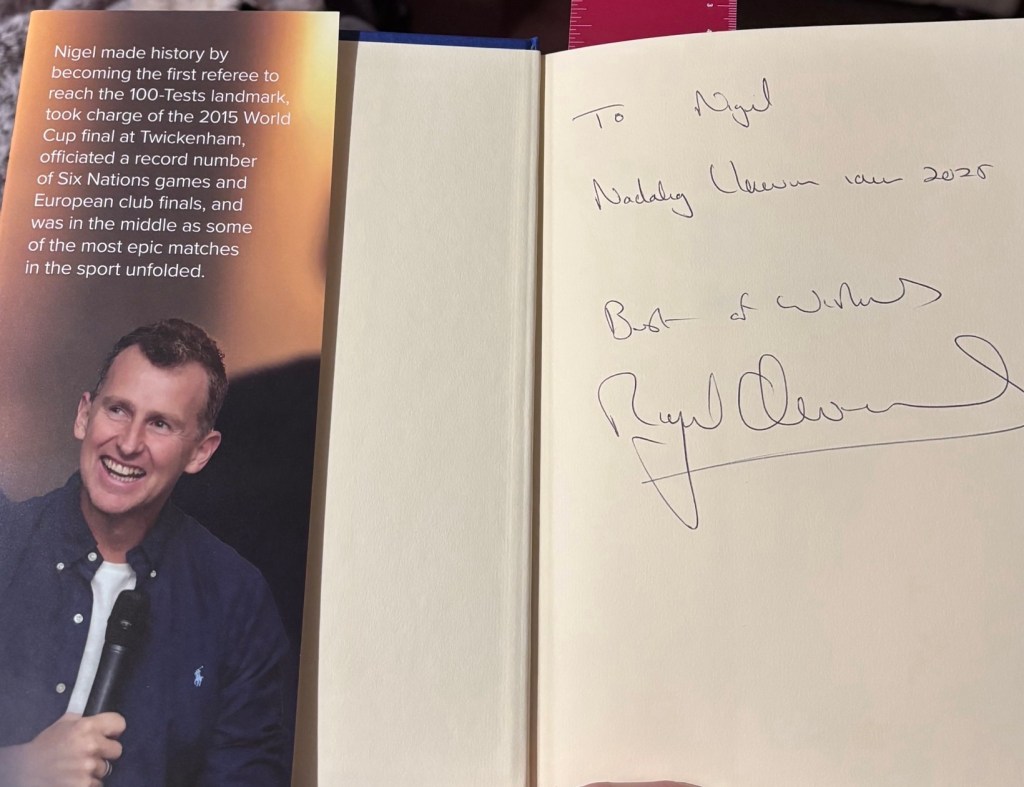
It will take pride of place amongst my growing collection of books with inscriptions.

Diolch yn fawr Nigel
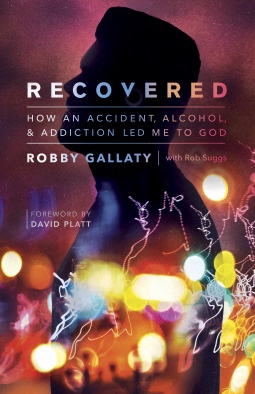
RECOVERED by Rob Gallaty

Recovered. Rob Gallaty

From the off I have to tell you that I may have looked at this book from a different angle to which the writer would like. I am not religious, in fact I’m the very definition of an Agnostic.

I was intrigued by the fly cover information for the book. So I thought I’d give it a go, and I’m really glad I did

Rob Gallaty is today a successful pastor. His path to getting there is amazing

Rob narrates the book from his point of view, but I suspect he has had to ask for help in remembering some of the times he talks about, because for a lot of his teens and twenties he was lost in a chemically induced fog.

Raised in a happy Catholic family, in New Orleans,  he was diagnosed with ADHD and ADD but his parents shied away from the route of putting him on medication. From the start he admits his own flaws. He was the class clown that had to be the centre of attention and often found himself in trouble with his teachers.

Typically of somebody who suffered ADHD he threw himself headlong into anything he was good at or enjoyed, but quickly got fed up and bored with it.

As a teenager he played Basketball for his school, , standing at 6 foot 6, he was an imposing presence on the court, and enjoyed the adulation.

But when he went to college he was just another tall guy and his identity was lost, he was not the centre of attention he craved.  He also started to find the drug scene.

His final dive into the murky waters of drug taking were not actually his fault. Injured in a vehicle accident, that was not his fault, he became hooked on pain killers, but not just taking them, he found that by selling them he could make money.

Rob was good at everything he turned his attention too but always managed to press the self destruct button because along with his ADHD and ADD he has a highly addictive personality, and although in the early stages of drug use he considered himself a functioning addict, he soon spiralled down to his lowest point.

In fact after interventions and rehab he relapsed, and like a bouncing ball had highs and lows each good experience short lived as the bounce lessened.

But eventually he found his way out of the fog. Not as a Catholic but as a Baptist Pastor

His upward spiral is nearly as spectacular as the downward one

He has ups and downs but always with a focus. But unlike his other focuses in the past, this one never got boring, he never lost his interest. He relates to the bible, he relates to God, and as he looks back at his history he is convinced that somebody has been looking over his shoulder and protecting him.  After all many of his friends are dead form over doses, and many are in prison for dealing, but Rob is recovering and he has a clean police record.

Why did I say at the start that I looked at this boom from a different angle.  I admire Rob for what he has achieved. For me the story is more about survival and growing up. His determination to make something of himself shines through throughout the book.  If it wasn’t for that vehicle accident would he have gone down the drugs route, possibly.

If he hadn’t gone down the drugs route would his addictive personality led him to something else, alcoholism, gambling, possibly.

Would finding a focus have helped him avoid these things. I think not, because with most interests of this type there would have been a stress related to it, which may have led him down one of these paths.

What I think he found in the life he leads is a tranquility that no drug could give him.

A friend of mine often tells me that “ we get you all in the end”  referring to his religion. He is one on the nicest people I know. He is also one of the calmest and exudes  tranquility even at the most fraught of moments.

I’m glad “somebody” Got Rob Gallaty, and I’m glad he’s shared his experience. This is a tremendous account of survival.

Notes of a Russian Sniper and American Sniper

Notes of a Russian Sniper Vassilli Zaitsev

American Sniper    Chris Kyle

As well as police procedural novels one of my passions in reading is biography’s or biographical accounts of historic events.

I’m not into celebrity, its usually Military, Fire, Police or Adventurers that I read. Recently I have read two books autobiographical books about Snipers.

Notes of a Russian Sniper-Vassilli Zaitsev is the book, and the person, that the film Enemy at the Gates was based on and is an account of a Russian Soldier who is recruited to the army during the second World War.

Transferred from training straight to the battle of Stalingrad Zaitsev recounts the utter devastation of the city during the siege by the German Forces. Describing hand-to-hand fighting and bombing in a strangely matter-of –fact way that transports the reader to the heart of the battles.

Zaitsev soon found a notoriety amongst his fellow fighters (both civilian and military) as a brave man, although he would not say so himself, its was not until he had been on the front line for a while that people realised he was a good shot. He had been raised in a family where hunting was a way of life and lying still patiently waiting for a shot came as second nature.

As word spread amongst the Russians he quickly became a folk hero and had a big effect on the moral of his fellow fighters.

He also gained a reputation amongst he Germans who tried to identify and target him. Crack snipers from the German Army were dispatched to find and kill him, some even came close.

This book not only describes Zaitsev’s experiences but its also one of the most descriptive books I’ve read on the siege of Stalingrad.

The other book I read was American Sniper by Chris Kyle. From 1999-2009 Kyle was a sniper for the American Seals special forces teams. He holds the record number of kills for an American sniper. The book describes Kyle’s exploits but the realm of modern warfare. He describes taking shots from 1000’s of metres, working in teams where he is guarded by groups of other soldiers with air cover and evacuation helicopters as part of the operations.

The two books could not cover such different conflicts.

The two authors are very similar in character, although Zaitsev does not go into his personal life as deeply as Kyle.

The comparisons are easy to see in their ethics and how they thought with one big difference. Zaitsev was at war to survive, Kyle fought a war on a different continent to where his lived and chose to do what he did. Zaitsev did it out of necessity.

It strikes me as strange that although both of these films have been made into blockbuster Hollywood films most people will only know of Kyle.

Most people don’t even realise that The Enemy at the Gate was based on a real person.

For me Notes of a Russian Sniper is by far the better book, and I suspect it is also the more accurate reflection of events.

Both these books are worth reading, in fact I’d suggest they were both read, but if you only read one.

Read Notes of A Russian Sniper.