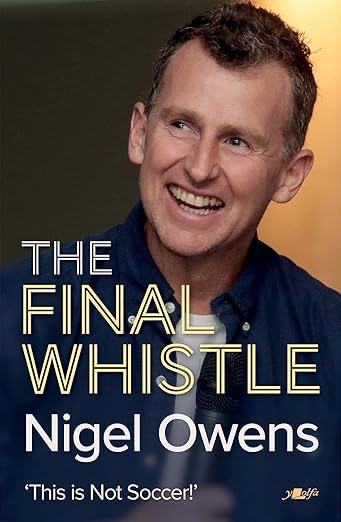
The Final Whistle. Nigel Owens

Before I start on the content of the book I’ve just got to comment on the quality of it.

It’s been a while since I held a book that was so aesthetically pleasing, and made of such good quality materials.

The paper quality is really nice, the text is printed in a lovely format, and the two sections of pictures are plentiful and have quality images.

I don’t think I’d realised how badly presented books have become until I picked up this quality product.

So what about the content.

I’ve been a fan of Nigel Owens for years, since well before his one liners and comeback responses started to go viral.

This is a second autobiography by Nigel, Halftime being the first. This book pretty much starts at the darkest time in his life. It’s no secret that he had attempted suicide, and that he’d been very nearly successful. In this book he lays out how he got to that point.

He also details the struggles he had with coming out. Announcing to the world that you are gay can be tough at any time, but within the world of professional sport, particularly one seen to be so alpha male macho, it must have been terrifying.

The reaction from the general population, and in particular the rugby fraternity was fantastic, apart from the odd moron.

The descriptions of some of the memorable moments in his career are an absolute must read for any sports fans.

It’s a measure of the man that he speaks as fondly of refereeing matches in his local Llanelli and District League, as much as he does of refereeing massive internationals between the top countries in the world.

His progress through officiating rugby games sees him taking charge of the World Cup Final in 2015 between New Zealand and Australia. The man with the best seat in the house gives a great account of this, and many other games, most rugby fans would have dreamed to have been in the crowd for.

His self analysis is humbling. Where many would have considered they had done a great job Nigel looks at the one or two decisions he, and his team of officials got wrong.

He’s at pains to point out that the one referee we see is not alone in running the game, touch judges, fourth officials and the TMO, all get credit, and the occasional tongue in cheek jibe. Step forward Wayne Barnes.

He talks about the isolation of the officiating teams during world cups, the elimination of the referees, not always being put down to their performance, but also the success of their home nation. A referee can’t officiate in a game in which their own country play, but also, and as a direct result of a championship he refereed in, they can’t officiate in a game that could have an influence on their home teams progression.

Imagine being the best in the world at what you do, but never been able to reach the pinnacle of your profession because you come from country that keeps getting to the World Cup final. I’m tempted here to say thank god Nigel Owens is Welsh, but as my wife is from Llanelli I might let that slide.

Perhaps the hardest thing to do when you enjoy the job you do, especially when you do it so well, is to know when to quit.

Nigel covers this in the later chapters of the book. A decision that was so nearly taken out of his hands. I recently heard another sportsman say that people at the top of their game are the first to know when they are losing that edge, that extra yard of speed, that extra ounce of strength, but they are the last to admit it.

Nigel seems to be the opposite to this. Towards the end of his career he was slowing down, even though he was in great physical shape. The trouble was rugby was changing, and even the pack were now, in the majority, becoming racing snakes built like brick outhouses.

He didn’t step back and think he couldn’t keep up. He sought help and changed the way he reffed the game. Took up different positions on the pitch, and extended his reign as one of, if not the top Rugby Union Referees right up till the end.

What did he do when he retired, not only is he running a farm with his partner, he has a media presence, and why not he has a great personality.

But the things he mentions right at the end of the book, almost as a few throwaway comments, about how he is helping the next generation of Welsh Rugby Officials will guarantee his legacy.

And whilst the rest of the WRU seems to be in disarray at least we will know the the future of the officiating is in good hands.

Max Boyce used to sing about the The Outside Half Factory buried in the Valleys of West Wales. With Nigel Owens on the production line I’m sure it’s about to reopen producing the men and women in the middle, giving us great match officials who can run a game with a smile on their faces whilst commanding full respect from the players and fans alike.

A brilliant read

My wife got me this book for Christmas and Nigel had put an inscription inside the cover.
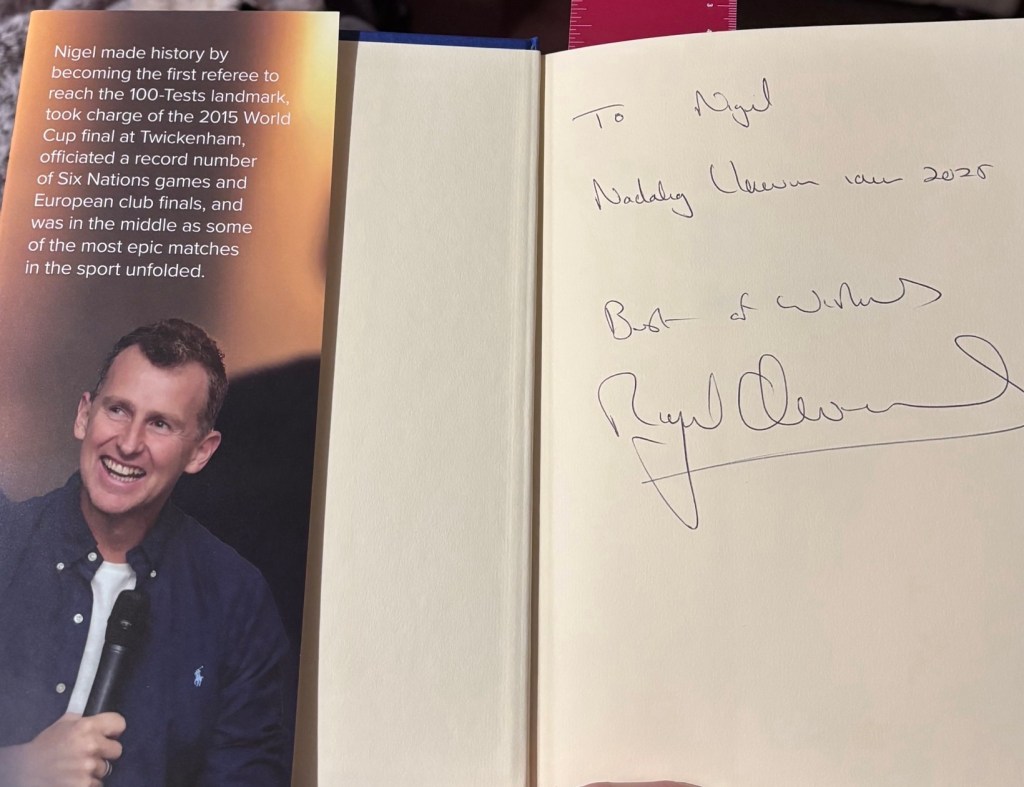
It will take pride of place amongst my growing collection of books with inscriptions.

Diolch yn fawr Nigel
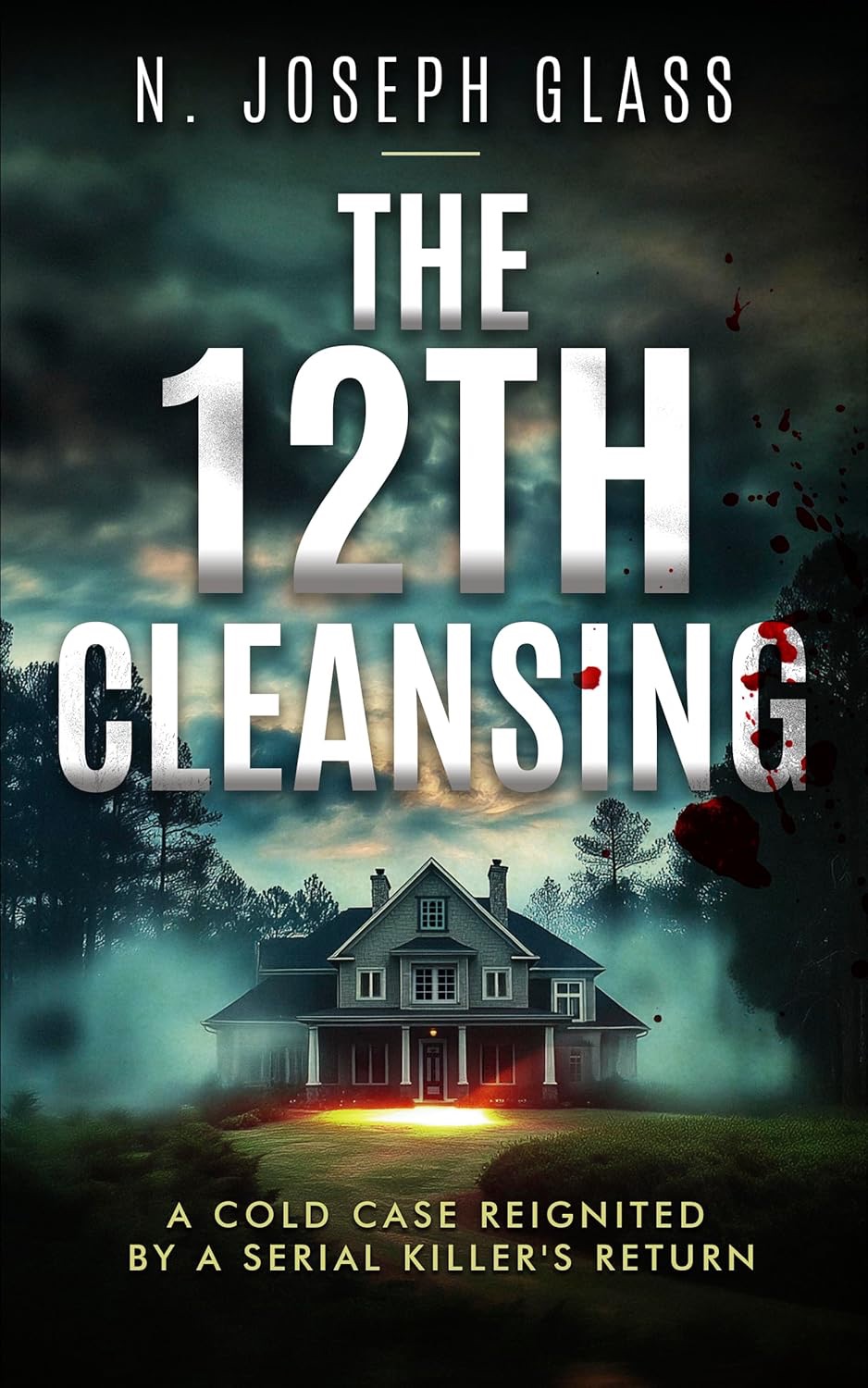
The 12th Cleansing. N. Joseph Glass

I may have left on of the best reads of 2025 to one of the last reads of 2025.

N. Joseph Glass is a new name to me but one I will be watching out for.

The story is that of the investigation into the murder of Sandra Rawlings, an innocent 17 year old, church going girl.

A girl who it appears has been murdered by a serial killer who had previously killed eleven young girls, of a similar age, but having not been caught has laid dormant for four years. Is Sandra really the 12th victim of a man who killed girls who had either just lost their virginity, or are just about to.

The story is cleverly told via six main characters, all of which have equal billing. Each chapter has one of these characters at its centre but is not written in the first person.

Walker Michaels is the veteran senior detective who was the lead on the first series of murders. A middle age man with virtues and an ethos that are typical of his age and experience.

Brandon Jones, the junior detective on his first murder case. His youth and enthusiasm, along with his misplaced confidence and machismo getting him into trouble with his more experienced partner.

The other main characters are the immediate family of the dead girl.

Allen Rawlings, a hard working man who is a pastor in the local church. An oxymoron of a man he rules his own house with a sullen harsh hand. At the same time he is having an affair with a foxy single mother in his congregation.

His wife Sonya, the down trodden and at heal wife who outwardly defends her husband attitudes and actions, whilst secretly harbouring more liberal thoughts.

Their son, Connor, a typical moody teenage boy who spends most of his time on his computer shielded from the outside world by his headphones. His sisters death brings him closer to his mom and he starts to rebel against his dad.

There are peripheral characters that add to the investigation. The mysterious M, who it quickly become obvious is a killer.

Pete, one of the other Pastors and Charlotte, the single mother Allen Rawlings is having an affair with.

The plot is nicely written with a fast pace.

I like to think I’ve usually got an idea of who the killer is relatively early in a book, not this one.

And the reveal when it came, although surprising, wasn’t one of those unlikely or unrealistic reveals. It was perfectly in context, just really well hidden.

Pages: 404. Publishers: Monocle Books. Available on Kindle unlimited.

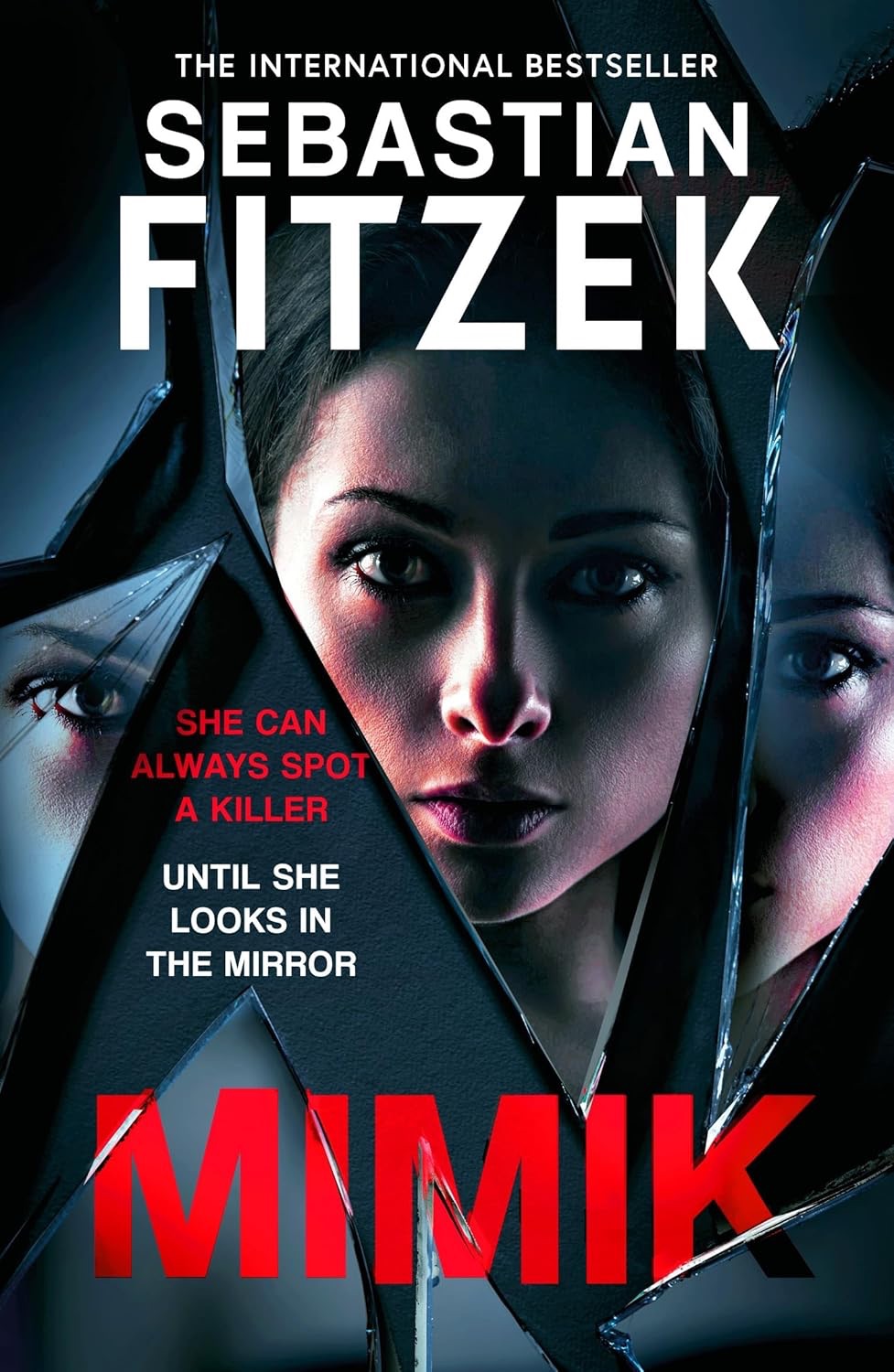
Mimik. Sebastian Fitzek

Adverts for this book kept appearing on my timelines, and after reading the gumph, and some reviews on Amazon I decided to give it a go.

I wasn’t disappointed, at first.

I read on a kindle so page numbers don’t really mean anything but at 85% into the book things started to go rapidly downhill.

The pretext of the book is that a woman, Hannah Herbst, has confessed to killing her family; her husband and their son, and her step daughter.

She is a consultant that works for the Police examining facial expressions and reading lie tells.

The problem is she cannot look at her own face in the mirror, scared of what she might see in her own personality.

It is a real problem when she wakes up with short term memory loss having suffered a self inflicted knife injury following the attack.

She’s been arrested and has made a full confession, on video.

The man showing her the video of her confession is also a serial killer, and he has taken Hannah hostage when he escaped.

All this might sound very confusing but it’s actually the backdrop to a really good story, up until that last 15% of the book.

It becomes evident quite early on that Hannah probably didn’t carry out the attack that left her husband and step daughter dead and her son missing presumed taken and killed.

But that last 15% basically shifts through every character named in the book being identified as the killer only for each hypothesis to be wiped out by the next.

Each is more fanciful than the previous and as a reader I was left giddy by the amount of twist and turns the last few chapters took.

I don’t do star rating but if I did, the first 85% would be a 5 star rating, the last 15% a generous two star.

Pages: 341. Publisher: Head of Zeus

Black Dog. Stephen Booth

Every now and then a TV series will hit the screens stating it’s based on the books of a best selling author.

If the series looks good I’ll try to read the book before watching the program, especially if I’ve never heard of the book series.

This was the case with the Copper and Fry series that recently started on Channel 5 (UK November 2025). The previews looked really good so I looked up the books. I was surprised I’d never heard of Stephen Booths books, there’s 18 in the series, and it’s my favourite genre.

Black Dog introduces DCs Ben Cooper and Diane Fry. Who police the Peak District.

Cooper is a local man. He is well respected and thought highly of by his peers and bosses, and is favourite to be promoted into the upcoming vacancy for a DS.

Fry is a fast track graduate who has just transferred from the West Midlands Police.

They are polar opposites in their professional approach, private lives, and attitudes.

Cooper is very much the local lad cop, he knows everybody and everybody knows him, the problem is many civilians only know him as his father’s son, a well respected Police Officer who died on duty.

And that really annoys him.

He has problems at home, his mother is suffering severe mental illness, and it’s taking its toll on him and his extended family, all of who live on the family farm.

Fry is battling her own problems, her and her sister had been in care since she was very young, her sister, already a drug addict, hasn’t been seen since she was sixteen.

Then there’s the reason she left the WMP, a dark secret she is desperate to keep from her new colleagues.

Set in 1999 the police are still plagued by old attitudes, especially towards fast tracked graduates, who have come from a Met force, and just happen to be young attractive females.

The story of the murder which is investigated in the book almost seems secondary to the setting the scenes of the two main characters and preparing the reader for what is to come.

For what it’s worth the murder is that of a young girl. The daughter of a couple that moved into a large house in the peaks. Rumours abound that orgies and sex parties are regular occurrences at the house.

Three old men, World War Two veterans are at the centre of the investigation. Arrogant doesn’t begin to describe these characters and they quickly become frustrations to the police, and the reader.

Fry and Cooper work together as DCs and in a way there is a begrudging respect beneath a simmering contempt. Expected a will they, won’t they, thread in the series.

I enjoyed the story and the characters, but, and for me it’s a big but, there is way too much spurious writing. As an example Fry leaves the Police Station after one of her first shifts, and goes straight home to her flat. That journey takes eight pages and contributes nothing to the story, and there are a lot of examples of that throughout the book.

There were times I found myself speed reading through five or six pages that held no relevant content.

Will I read more of the series. Yes, it will be one of those I dip into occasionally but it won’t be one I binge read.

Pages: 537. Publisher: Harper Collins