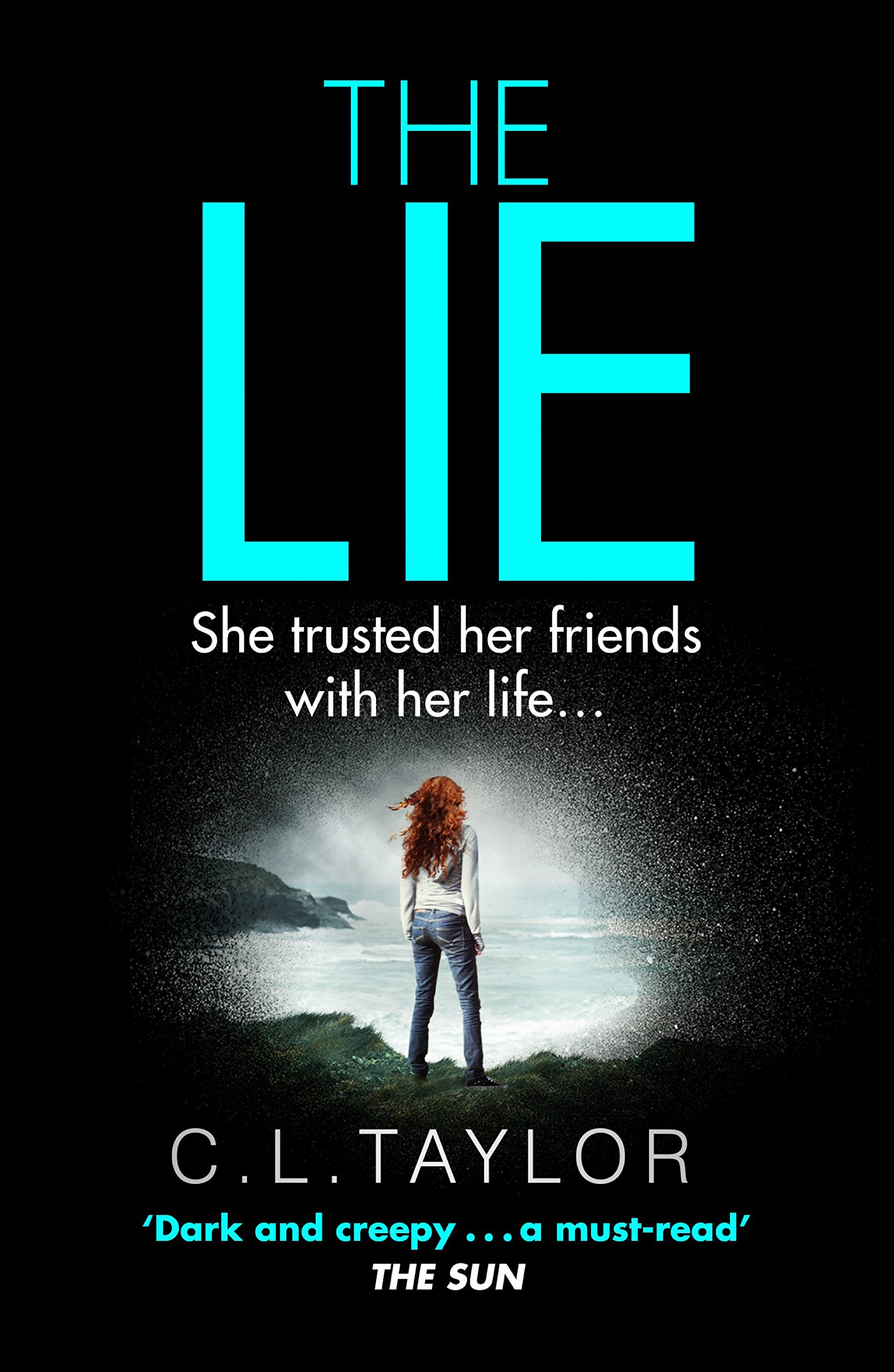
The Lie C.L. Taylor

THE-LIE-by-C.L.-Taylor

The Lie       C.L. Taylor

A few days ago I saw a picture of a newspaper article about The Lie. The person who posted the picture on Twitter is an author I read and admire so I looked the book up, not my usual read but it got my interest. WOW am I glad I read it.

The story is set in rural Wales in the present day, with flashbacks to a period five years ago.

The lead character Jane Hughes is working in an animal rescue centre when her past begins to catch up with her.

Five years ago she had been on a holiday with three friends to a Himalayan retreat where things had gone terribly wrong. The ramifications of the incident start to play out in the present.

The book looks at the demographics of a group of women who met at University. It openly looks at the friendship, bitchiness, swings in friendship and the destructive effects it has on the group. Its honest, it will make you think about same sex groups of friends and how the relationships alter over time.

Everybody knows such a group. The usual traits are there: “I’m your friend because she, is not because I like you”. “I will make her like me more than she likes you”. Twist this in with one, or more, of the friends being psychotic and you have a volatile mixture.

The friends take a holiday to what they think is a Retreat but turns out to be a fledgling cult.

What happens at the retreat will have to be read because I’m not going to spoil it.

To say this book is a physiological thriller is an understatement.

During the flashbacks to the time the women spend in the retreat the author handles the physical and mental abuse, along with the attempts to indoctrinate the girls into the cult, with a skill that will keep you turning the pages but also make you scared to see what comes next.

Who would I recommend this book to? Everybody.

It’s one of those books that will be enjoyed by men and women.

I’m going on holiday in a few weeks time and I wish I’d saved it till the flight. This would have made ten hours in the air pass in the blink of an eye.

Looks like I’ll just have to put The Accident on my Kindle and hope it’s as good.

The Inspector Pekkala novels by Sam Eastland

The Inspector Pekkala novels by Sam Eastland

Three of my favourite genres of books are, War, Police, and Espionage novels. When I found the first Inspector Pekkala novel, Eye of the Red Tsar, I knew that I had found a gem amongst stories.

Eastland takes real events and weaves an excellent yarn around them. Inspector Pekkala was once the favourite detective of the final Tsar of Russia. Equally feared and respected across the country he built a solid reputation and gained the trust of the royal family. Following their murders he his hunted down by the communists and sent to a gulag deep in the heart of Siberia where he is given a job no man is expected to survive. Living in the vast forests he is left to fend for himself and develops a mythological status amongst the other prisoners.

Stalin himself sends an officer to release Pekkala from the prison with a guarantee of freedom if he can identify the real killers of the Tsar and his family. The book brings to life the terrible conditions within Russia at the time of Stalin’s reign. Pekkala is a wonderful character with a unique set of personality traits. He is thrown together with the man who was sent to release him, Kirov, a man who becomes his side-kick and forms an unusual friendship with the inspector, which develops during the series.

The second book The Red Coffin is set immediately prior to the outbreak of the Second World War. Pekkala, now established as Stalin’s main investigator, is sent to investigate the death of the designer of the T34 tank. The designer was killed before the tank was completed; several prototypes had been made and were in the process of being tested at the time of his death. One of the prototypes is stolen and is used by a group of anti-communist Russians in an attempt to provoke German forces to invade Russia with the hope of rousting the communist party. Pekkala and Kirov are sent to the T34 test grounds to investigate the death of the designer and locate the missing tank. This is not only a great story but also describes the tensions between Russia and Germany at the end of the 1930’s. The two main characters develop in this book making them one of modern fictions great crime teams.

In real life the T34s designer was killed by pneumonia as he attempted to drive a prototype over a 1000 miles in a demonstration of its capabilities. This story cleverly uses some of the known facts whilst staying completely within fiction.

Book 3, Siberian Red, is set at the outbreak of the war. Stalin learns of a man who is offering information on the whereabouts of the lost treasures of the Tsars. The man with the information is a convict in the same Siberian gulag that Pekkala was a prisoner in. Before he can be questioned he is murdered and Pekkala is sent to investigate the crime and try to find the location of the treasures. In what is like a living nightmare Pekkala is forced to leave Kirov behind and return to the gulag, undercover, as a prisoner. This book builds on Stalin’s greed and insecurity. He wants the treasure but he is also afraid of the White Russians, soldiers who were loyal to the Tsar, and have since formed a group in prison, and amongst the battalions of Stalin’s army. Back in the gulag Pekkala fights for his life whilst trying to gain information of the killer of the informant, and find a location for the Tsars treasure.

In the fourth book, The Red Moth, Pekkala is summonsed by Stalin following the finding of a picture. The picture was found in the bag of a single passenger of a German Scout plane. Stalin believes there must be more importance to the picture than anybody understands and Pekkala quickly confirms his thoughts. The picture contains information on some of the lost treasures of the Tsars. It also alludes to the fact that the Germans have located and were going to ransack the Amber Room, a room that was panelled in ornate Amber in one of the Tsar palaces, and take it to Germany. Pekkala is dispatched to locate the room and bring the panels back to Moscow before the advancing German troops can carry out their orders. The book has a great story and includes a moral dilemma for Pekkala, if he cannot recover the Amber should he destroy one of the great works of art to stop it falling into German hands. At the end of this book the outcome is revealed but at what cost.

Again this story revolves around real events. The actual Amber Room was located in Catherine Palace, near St Petersburg. It was overrun by German military units during the war and the contents were looted. The panels of the Amber Room have never been found, and to this day remain one of the great mysteries of the war, and one of the world’s great lost treasures.

Book 5, The Beast In The Red Forest, starts about 18 months after the end of book 4. Pekkala has been missing, presumed dead, since his attempt to locate the Amber Room panels. Stalin receives word that he may be alive and dispatches Kirov to the front line to locate him. Set against the ever changing back drop of the war between the Russian Army, the German Army, and the Partisan Army this story is more about espionage than the previous books.

Is Pekkala alive, will Kirov find him, and if he is alive why has he been anonymous for so long. All these questions are answered against a backdrop of close war, where front lines move backwards and forwards less than 100 yards a day, and in the background is a hidden plot that is only revealed in the last 50 or so pages.

Throughout this series Eastland examines life in Russia under Stalin’s reign. He uses Stalin’s flawed, psychotic personality, to bring a depth of threat not only to the main characters but shows what a threat he was to the world.

Pekkala is a wonderfully deep character. Life as the Inspector for the Tsar gaves him the investigative skills. Life in the gulag gave him survival skills. Life as Stalin’s Inspector gives him dilemmas which we may, or may not, agree with how he deals with, but one thing is for sure. I cannot wait for the next book.

I have used the UK titles for the books in this blog. If you want to find the alternative titles or read more there is a great website dedicated to these books www.inspectorpekkala.com

Believe No One A.D. Garrett

A short blog this time but about another brilliant book by the writing partnership A D Garrett.

Believe No One is a great story with DCI Kate Simms and Professor Nick Fennimore at the centre of  a crime which strikes a startling resemblance to the disappearance of Fennimore’s wife and daughter some years earlier.

The story starts some months after the end of Everybody Lies, and although this book could be read as a stand-alone novel, I would suggest reading the prequel first.

Simms is seconded to a multi-agency task force in America looking at the different methods of investigation used in the USA and the UK. The team are looking at cold cases when they come across a link between several Murders, a link which has been missed because of the territorial issues faced by American law enforcement agencies.  The more the cases are examined the more similarities are found with the disappearance of Fennimore’s family; but is it all coincidence?

Meanwhile another Police Deputy in the States recognises the similarities between a case she is currently investigating and one she had dealt with in a neighbouring County. She contacts Fennimore for help and he heads for America. It is not long before the different investigation teams get together and start to piece together the activities of a serial killer.

The narration of the book follows the main 2 characters but the introduction of a third main character, a young boy who becomes a victim of the killer, gives the story an extra dimension.

This book is a good read. Again the writing partnership of an established author with a Forensic practitioner has produced a realistic and believable story.

At first I was concerned about the ongoing background story of Fennimore’s investigations into the disappearance of his family, in a story which has yet to be told, but now it has me as hooked as one of those cliff hanger season finales on TV dramas.

I hope the next book in the series is out soon. I can’t wait to read it.

Everybody Lies A.D Garrett

Everyone Lies A. D. Garrett

Well I seem to have spent most of 2014 discovering new British authors writing some great crime novels, and it seems that I have left one of the best till last. Amazon suggestions came up trumps when they directed me towards Everyone Lies by A. D. Garrett

This police procedural novel is set in Manchester and the story is based around murders in the sex and drugs industries. If you like gritty, true to life, realistic stories, this is for you. If you don’t like reading about the violence that surrounds the subject then it’s probably best you don’t read this book, but you will be missing out.

From the beginning it is obvious that violence is going to be central to the theme in this book. In some books it’s there for the shock factor, in this one it’s inherent to the tale being told and is used as a tool to describe the viciousness of life within inner city drugs and prostitution trade.

The two main characters DCI Kate Simms and Forensic Practitioner, turned lecturer, Nick Fennimore come together to investigate a spike in drug related deaths and soon uncover a link to the violent deaths of two young prostitutes.

As the investigation progresses and the bodies mount up political, and hierarchical, pressures are put on to DCI  Simms. Her relationship with her colleagues is strained and she increasingly relies on the help of Fennimore. Whilst the story is told it becomes obvious that the two have history and that they have both suffered professionally, and in Fennimore’s case personally, during a previous investigation. Although rules are broken the story remains believable.

The forensics in this book are second to none I have read in a work of fiction, and it came as no surprise to find out that A D Garrett is the pen name of a writing duo; Margaret Murphy a prolific writer of crime novels; and Proffessor Dave Barclay, a Forensic Practitioner/ Lecturer who I cannot help but wonder if the character of Nick Fennimore was at least partially based on.

There are places in the book where it is tough reading not just because of the violence but because of the science. Fennimore is a great believer in applying Bayesian Statistical Analysis, and uses it to build his initial hypothesis, which is great as long as you understand it. Thankfully I do.

Margaret Murphy has a section on her web site where she discusses the use of graphic violence in her novels. I agree with everything she said in the article, and this book is a perfect example of her reasoning. The violence is there. Is it graphic, in my opinion yes but not shocking. She describes violent actions which people would rather not accept are happening, they are. Without those passages in this book it would have been just another crime novel.

So we have a collaboration between a no-holds-barred novelist, with an up to date Forensic Practitioner. What’s not to like.

The second book in the series is already on my Kindle and hopefully it won’t be the lasteveryone-lies-200px