
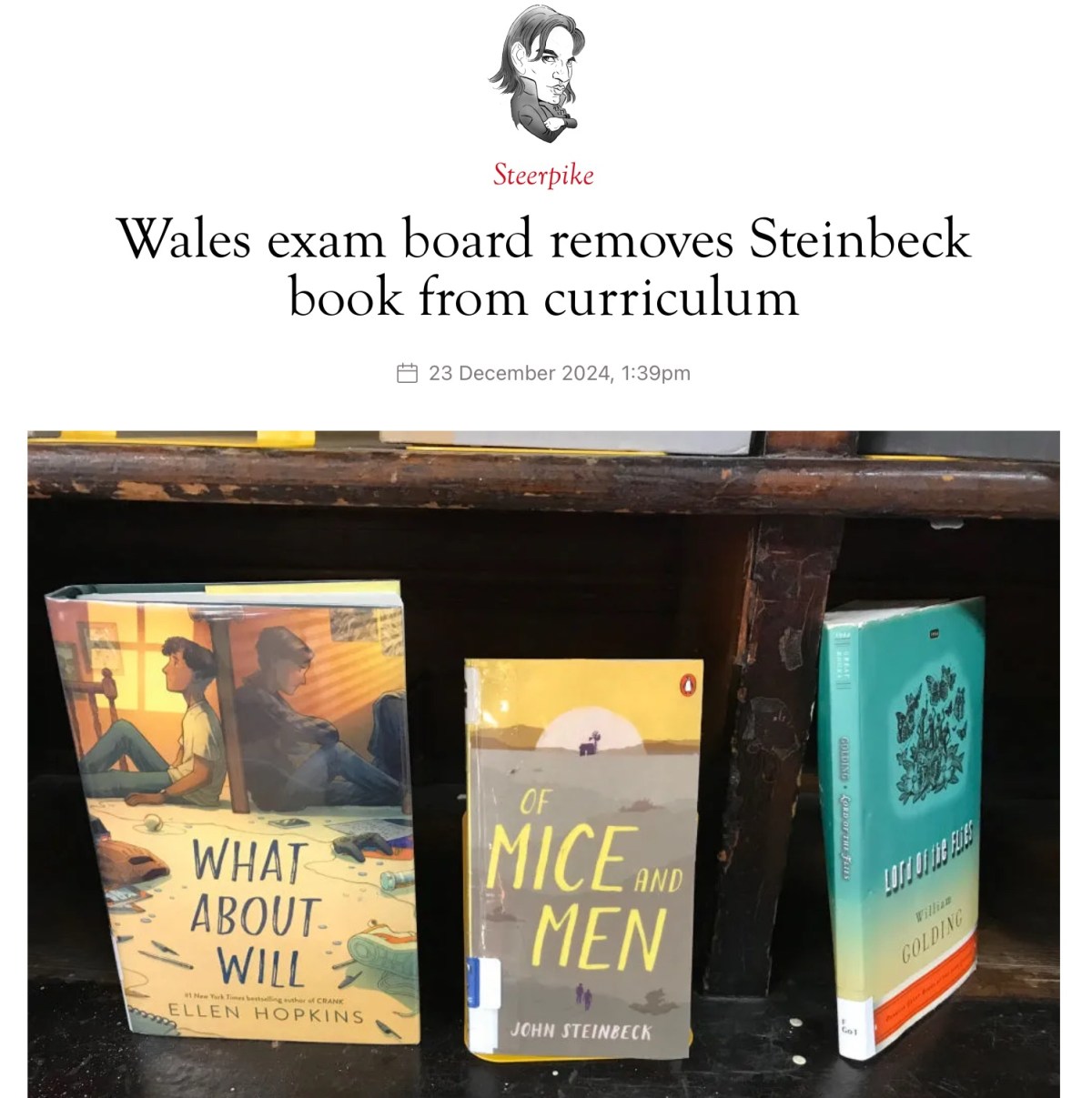
A recent headline in Wales got me thinking. The Welsh Joint Education Committee have banned the “Classic”, John Steinbeck’s Of Mice and Men, from its GCSE reading and studying list, stating racism in the writing could be seen to be offensive.
This got me thinking.
What is a a Classic, and why do we class some books as classics, what are they actually supposed to teach us.
At secondary school, in the 1970’s I was made to take CSE English Literature. Some of my brighter friends took it at O Level.
I didn’t read any of the books on the reading list. Mainly because I found them boring and stuffy.
I’ve read many of them since, and some of them I even found entertaining. But what was I supposed to learn from books like Lord of the Flies, White Fang, Rebecca, and others I can’t even remember.
My friends taking O Level suffered even more, Dickens and Shakespeare weighed heavily on their reading list.
Growing up on a huge council estate in Birmingham, these books bore no relevance to anything we were experiencing.
At the time my reading was mainly based on my father’s discarded WWII paperbacks and the occasional spy book. At thirteen these held relevance. The war was over but still recent enough to be fresh in the mind of many of the adults in my life. The Cold War was at its height.
What I didn’t know at that time was just how much reading would mean in m life.
I’m a bookworm with my own review blog. I get sent advanced copies of books so that I can review them prior to publication.
I embrace reading and love to think that I encourage other people to read.
How do I do this. I tell the truth about books I enjoy. I never write a negative review, because I know reading is subjective. Just because I don’t like something, why should I write something that might put somebody off a book they would really enjoy.
To flip that why do education boards select books, Classics, that have no relevance, and in all likelihood will put people off reading in their formative years.
I understand that some people will want to study and research the history of literature and writing styles. That can be done at Higher Education for that minority group.
To ban a book because it has historical, but accurate for the time, phraseology, in my mind, is counterproductive.
We should learn from the past, bad things as well as good.
One of my favourite writers, in American Fiction, is Chester Himes. His Harlem crime series, set in post war New York is full of information that would be hard to find in many none fiction books.
His main characters Coffin Ed Johnson and Gravedigger Jones, are fierce, black detectives, working in the slums of Harlem.
Chester Himes was born in the early 1900’s and lived in a similar area to that which he wrote about. His accounts, although fictional are true to life.
Another American author, whose books would be seen to be offensive by some is James Ellroy. The LA Quartet contains era appropriate, and accurate language. Loosely based on real life events, the fictional characters often interact with real people of the time.
Some of the content would be massively controversial today.
In my mind, these are Classics, and if you read these you cannot help but compare the occurrences of, in Himes case the 1950s, and in Ellroy’s case the 1960s, with today’s society.
It’s not just American writers.
Colin Dexter, in his Morse books, plots the changes of Policing in the 1980s. Language and attitudes accurate to the era are vastly different to that of today, they can be seen to be changing throughout the series.
The books are entertaining but also allow the reader to look at how much has changed in the U.K. over the last 40 years or so. In life in general, as much as Policing, things changed vastly during that era.
There will be people who love Agatha Christie, I’m not one of them. Her books would be classed as cosy crimes today. The language and attitudes in her books are another example of accurate for her era, but would be found offensive today.
In my mind we shouldn’t be banning books because of when they were written, we should embrace and learn from them.
Do we learn from the Classics? Writing styles maybe, but societally no.
They are too far in the past. Dickens wrote about the mid to late 1800s. Shakespeare wrote about the 1500s. This is history and bears no real relevance to modern literature, so how are they still on Literature Reading Lists., below higher education.
Everybody will have their own opinions and I hope my little rant doesn’t offend, but I do hope it provokes some discussions.

 nigeladamsbookworm